It’s been a busy week that unfortunately left little time for writing. Among other things, I was finalizing plans for my trip to North Carolina, where I will get to lay eyes on Galen’s hometown and the shelter that put her on death row. I leave this afternoon. But this morning, as I ate left-over waffles and skimmed my favorite newspaper, I came upon an article that spoke to me. So since I have no story of my own to offer up, I recommend Four-Legged Reason to Keep It Together from the Sunday Styles section of today’s Times. Happy reading!

Monthly Archives: August 2012
Gryffin or Breastmilk?
I have extraordinarily healthy children. My older daughter will enter fifth grade having missed just one day of school in five years. My younger daughter enters third grade with a similarly stunning record. My husband and I are fortunate: We have two healthy, smart, beautiful girls.
I’ve always taken credit for the healthy part. I recall rarely being sick as a child, and I think I, too, made it through whole school years without an absence. But I don’t pat myself on the back because I passed on healthy genes. I do it because I breastfed both girls, and to say it wasn’t easy is one of the great understatements of all time.
My older daughter and I got off to a cruel start, perhaps because of her unexpected entrance into the world via C-section. Each feeding brutalized my breasts more than the previous one; my nipples were so raw I cringed when the cotton of even my softest T-shirt brushed against them. Being too stubborn and proud to give up, I kept at it, although I could never understand how something supposedly so natural, could be so awkward and, at times, feel so utterly impossible.
Ultimately, my body healed, and I nourished my child the “right” way, giving her all the benefits researchers say come from breast milk. We got so good at it, my daughter decided she had no use for a bottle, and for six months I was her sole source of nutrition. My younger daughter latched on more easily, but she decided to go bottle-free for nine months. What were the chances of that happening again?
Needless to say, I always figured I was the reason I had such healthy kids… until I read this in The Week:
“Finnish researchers found that children who lived with a dog were 31 percent more likely to be in good health than those who didn’t. They were also 44 percent less likely to have developed an ear infection and 29 percent less likely to have needed antibiotics… The more time pets spent outdoors, the healthier the babies that lived with them were, which suggests that dogs and other pets may track in dirt and germs from outdoors that ‘stimulates the immune system’ of babies ‘to do a better job of fighting off infection.’”
While my breasts suffered the wrath of my babies’ gums, Gryffin’s sheer presence in our home may have been as beneficial as my breastfeeding!
I often refer to Gryffin as my first child.
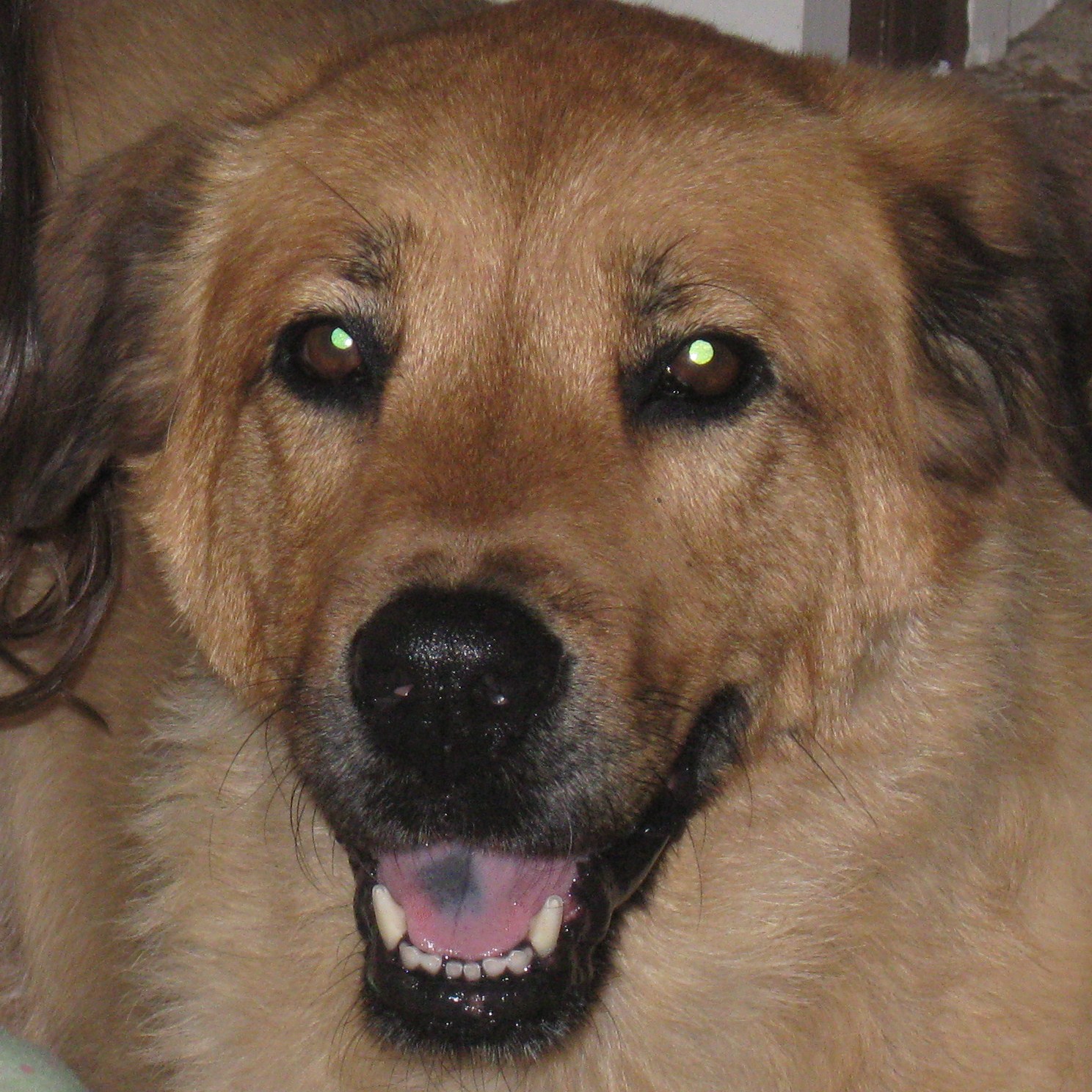
Gryffin
Kevin and I rescued him from an Atlanta-area shelter when he was twelve weeks old, and we were living in Philadelphia. I doted on Gryffin: He came with me to work, we walked around Rittenhouse Square together, and he slept on my bed many a night when Kevin’s medical training kept him at the hospital round the clock. My mother says Gryffin brought out my maternal instincts, and I agree.
I will always be indebted to Gryffin. He taught me I was ready to be a mom, not just to a canine kid, but to human kids, too. He was my protector in Philly, the alarm system that Kevin could count on to keep me safe when he pulled all-nighters at the hospital. Gryffin instilled in my children a love of dogs so strong that after he died, the girls persuaded me and Kevin to cut our mourning period short. Thus, we rescued Galen, whose name doesn’t start with “G” by accident.
And now it turns out, he may have given the girls the gift of health, via all the germs, mud, dirt, and grime he tracked in off the city’s streets and dog parks. If I’m worthy of a pat on the back for the girls’ good health, Gryffin surely deserves a pat on the head.
***
When I’m feeling magnanimous, I share some of the credit for our girls’ good health with Kevin, who is a strong believer in the hygiene theory, which posits that exposure to viruses and bacteria in early life strengthens a child’s immune system. Thus, he never panicked when one of our daughters took a toy from the floor and stuck it in her mouth – even after Gryffin, just back from the dog park, stepped on it.
Working Girl
There are morning people, and there are those who simply are not. My elder daughter rises early, and on those rare occasions I need to wake her, it takes only a kiss on the forehead or a gentle shake of her shoulder to elicit a warm, if sleepy smile. Not so, with my younger daughter.
In infancy, my younger daughter didn’t know the meaning of sleep. She refused to go down at night – we lived in Philadelphia at the time; my husband or I would put her in the Baby Bjorn, leash up Gryffin, and walk the city streets into the wee hours of the morning so her colicky screams didn’t wake up her sister – and she rose long before the sun. By the time she was a toddler, she could sleep until sunrise. When she started kindergarten three years ago, that changed. She didn’t become a late sleeper; weekends she was still up by eight. But weekdays she needed a little encouragement to get up in time to dress, eat, and catch the school bus.
Neither the kiss nor the nudge worked. Instead, I would sit on the edge of her bed turning her favorite stuffed animal into a puppet that would sing made-up wake-up songs and cover her face and belly with kisses. When her angry eyes blinked open, I was greeted with whining or groaning.
I dreaded most mornings.
Australian shepherds are herding dogs and as such, they were bred to work. Our dog, Galen, is part Aussie, and as a wild and overly-energetic pup, she would herd my daughters by nipping at their heels. A dog trainer I phoned for advice – I was afraid Galen was going to draw blood or send one of the girls tumbling down the stairs – told me that herding dogs, like Australian Shepherds and Border Collies, need a lot of exercise and even a sense of purpose.
Apparently, I needed to find Galen work around the house to make up for the absence of sheep and cows in our yard.
When Galen was about seven months old, I saw my older daughter sitting on her bed, encouraging Galen to jump onto it. I had high hopes of keeping Galen off all furniture, but my daughter undermined me. Evidently, beds aren’t furniture in the eyes of an eight-year-old. (In her defense, we had allowed Gryffin on our beds, thus why I wanted to keep Galen off. Obviously, I hadn’t made myself clear.)
Galen loved jumping onto the girls’ beds, especially when they were in them. And at some point – I can’t remember when – it dawned on me that I could outsource my morning job to the dog.
Now every weekday morning, whether the girls are rising for school or for summer camp, Galen wakes them up. It’s pretty incredible, really. I call out, “Galen, time to wake the girls!” and from wherever she is in the house, Galen dashes to my older daughter’s bedroom. I open the door, Galen jumps on the bed, sniffs my daughter awake – Galen is not a licker – jumps off the bed, and proceeds to my younger daughter’s room. I open the door, up on the bed she hops, a few sniffs, and my younger daughter wakes… with a smile. Then her hands snake their way out from under the covers to pet Galen’s head, as she quietly and lovingly says, “Hi, baby.”
It’s been a year-and-a half since I’ve had to wake my younger daughter. Instead, each morning I get to watch my dog and my daughter connect in a way that is so powerful and so beautiful. Best of all, though, a child who once began her day with a scowl now starts the day with a smile.
***
Weekends can be a problem. Sometimes at 7:00 on a Saturday or Sunday morning, I find Galen standing, tail wagging, in front of my older daughter’s closed bedroom door. I gave Galen a sense of purpose, and she’s given my girls a reason to wake up happy; but still, I like her to take weekends off.
The Fix
In September of 2000, Gryffin was on death row. I was just too naïve to know it. When I met him at an Atlanta-area shelter, I saw only an adorable 12-week-old puppy awaiting a home. He was black and gold and as friendly and clumsy as most puppies, but compared with his littermates, he was remarkably calm. His paperwork revealed he was a Retriever/Chow mix; the shelter named him Rebel. He was irresistible. I called Kevin, who was then my fiancé, and pleaded my case – Rebel’s case. The next day, Gryffin – the dog formerly known as Rebel – came home with me.

Gryffin using a sleeping Kevin as his pillow.
But what if we hadn’t adopted him? What if no one had? Then Gryffin would likely be dead, because each year in Georgia, more than 80% of dogs and cats at county shelters are killed, an estimated 300,000 animals, at a cost to state taxpayers of $100 million. Pregnant dogs and cats are killed upon drop-off.
“An epidemic is what it is,” says Ginny Millner, one of the founders of Fix Georgia Pets, an organization tackling the crisis of pet overpopulation, and “euthanasia isn’t the answer.”
For those of us living in the Northeast and on the West Coast, spaying and neutering dogs is common. In fact, Nora Parker, at New Jersey’s St. Hubert’s Animal Welfare Center, says it’s rare for dogs dropped off at its shelters not to be fixed.
That’s not the case across much of the South, where attitudes about dogs reflect the region’s rural and agrarian history. “People thought of dogs as animals, not pets,” says a good friend raised on a ten-acre farm in north Georgia. “A pet is something you care for. It lives inside the house; it is a companion.” Growing up, she says, people had “yard dogs” for protection. “If they didn’t protect your house they weren’t any good.” Healthcare for a dog, including spaying and neutering, was unthinkable. “People didn’t have extra money to spend on their kids, forget their dogs,” she says. So dogs lived outside the house, roaming freely, procreating at will.
Unfortunately today, much remains the same throughout large swaths of the South, resulting in females birthing litters that give rise to more litters. The numbers are so great that the ASPCA reports that “areas of the south are overwhelmed with more dogs than loving homes.” That’s why several rescue groups in the Northeast pull dogs from southern shelters, usually just days before the dogs are scheduled to be killed.
But rescue isn’t the solution, according to Ginny Millner, and no one in rescue disagrees. The term “band-aid” is bandied around a lot when talk turns to rescue. The solution – and the challenge – is getting dogs spayed and neutered.
Fix Georgia Pets, founded in March, is a non-profit organization devoted to raising awareness about responsible pet ownership and providing grants to clinics and organizations that provide low- and no-cost spay and neuter services to Georgia residents. Its goal: raise $5 million dollars to spay and neuter 100,000 animals in the next two years.
“It’s got to be done and it’s got to be done soon,” says Ginny Millner, “because the more you wait, the more animals you have.” And that means more animals living on deathrow.
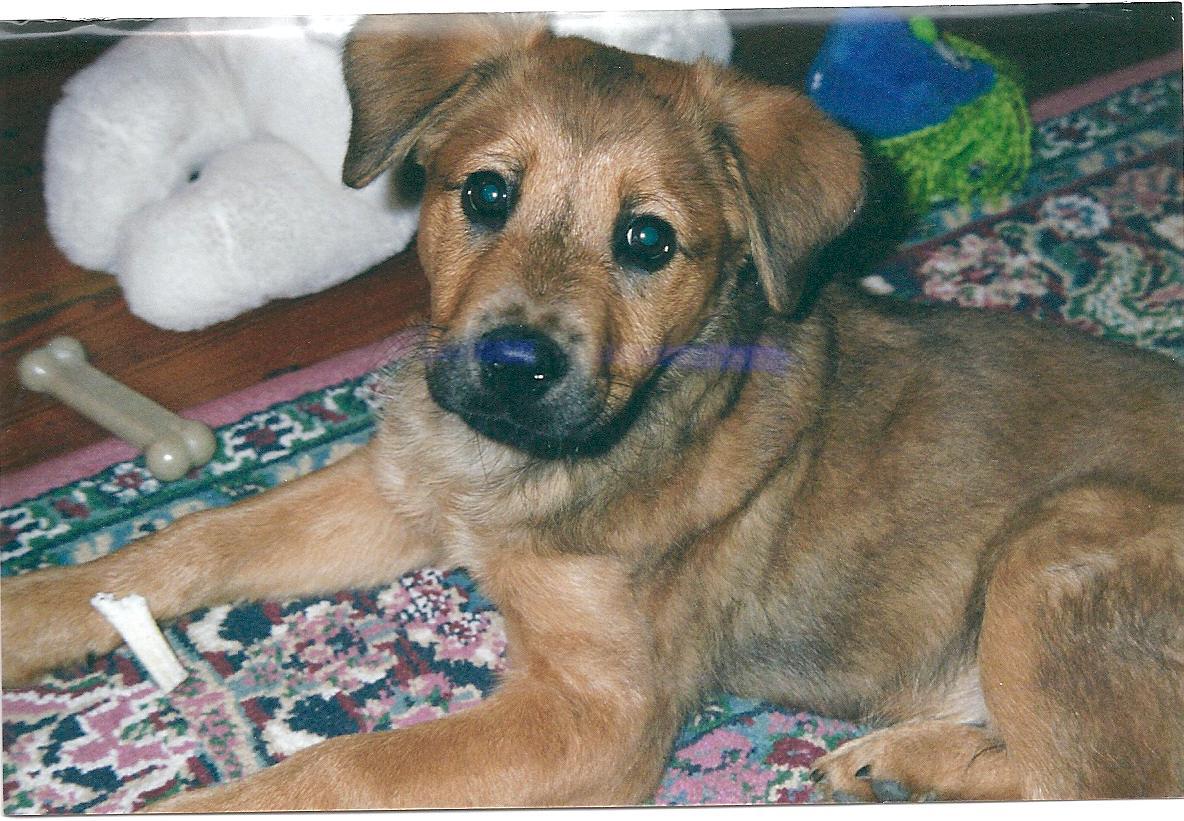
Gryffin, about four months old: spoiled, happy and very much loved.
***
Ginny Millner hopes Fix Georgia Pets will be a model replicated throughout the South. To learn more, go to www.fixgeorgiapets.org.
 she's a dork