Working Girl

There are morning people, and there are those who simply are not. My elder daughter rises early, and on those rare occasions I need to wake her, it takes only a kiss on the forehead or a gentle shake of her shoulder to elicit a warm, if sleepy smile. Not so, with my younger daughter.

In infancy, my younger daughter didn’t know the meaning of sleep. She refused to go down at night – we lived in Philadelphia at the time; my husband or I would put her in the Baby Bjorn, leash up Gryffin, and walk the city streets into the wee hours of the morning so her colicky screams didn’t wake up her sister – and she rose long before the sun. By the time she was a toddler, she could sleep until sunrise.  When she started kindergarten three years ago, that changed.  She didn’t become a late sleeper; weekends she was still up by eight. But weekdays she needed a little encouragement to get up in time to dress, eat, and catch the school bus.

Neither the kiss nor the nudge worked.  Instead, I would sit on the edge of her bed turning her favorite stuffed animal into a puppet that would sing made-up wake-up songs and cover her face and belly with kisses.  When her angry eyes blinked open, I was greeted with whining or groaning.

I dreaded most mornings.

Australian shepherds are herding dogs and as such, they were bred to work.  Our dog, Galen, is part Aussie, and as a wild and overly-energetic pup, she would herd my daughters by nipping at their heels.  A dog trainer I phoned for advice – I was afraid Galen was going to draw blood or send one of the girls tumbling down the stairs – told me that herding dogs, like Australian Shepherds and Border Collies, need a lot of exercise and even a sense of purpose.

Apparently, I needed to find Galen work around the house to make up for the absence of sheep and cows in our yard.

When Galen was about seven months old, I saw my older daughter sitting on her bed, encouraging Galen to jump onto it. I had high hopes of keeping Galen off all furniture, but my daughter undermined me. Evidently, beds aren’t furniture in the eyes of an eight-year-old. (In her defense, we had allowed Gryffin on our beds, thus why I wanted to keep Galen off. Obviously, I hadn’t made myself clear.)

Galen loved jumping onto the girls’ beds, especially when they were in them. And at some point – I can’t remember when – it dawned on me that I could outsource my morning job to the dog.

Now every weekday morning, whether the girls are rising for school or for summer camp, Galen wakes them up.  It’s pretty incredible, really.  I call out, “Galen, time to wake the girls!” and from wherever she is in the house, Galen dashes to my older daughter’s bedroom. I open the door, Galen jumps on the bed, sniffs my daughter awake – Galen is not a licker – jumps off the bed, and proceeds to my younger daughter’s room.  I open the door, up on the bed she hops, a few sniffs, and my younger daughter wakes… with a smile. Then her hands snake their way out from under the covers to pet Galen’s head, as she quietly and lovingly says, “Hi, baby.”

It’s been a year-and-a half since I’ve had to wake my younger daughter.  Instead, each morning I get to watch my dog and my daughter connect in a way that is so powerful and so beautiful.  Best of all, though, a child who once began her day with a scowl now starts the day with a smile.

***

Weekends can be a problem.  Sometimes at 7:00 on a Saturday or Sunday morning, I find Galen standing, tail wagging, in front of my older daughter’s closed bedroom door.  I gave Galen a sense of purpose, and she’s given my girls a reason to wake up happy; but still, I like her to take weekends off.

The Fix

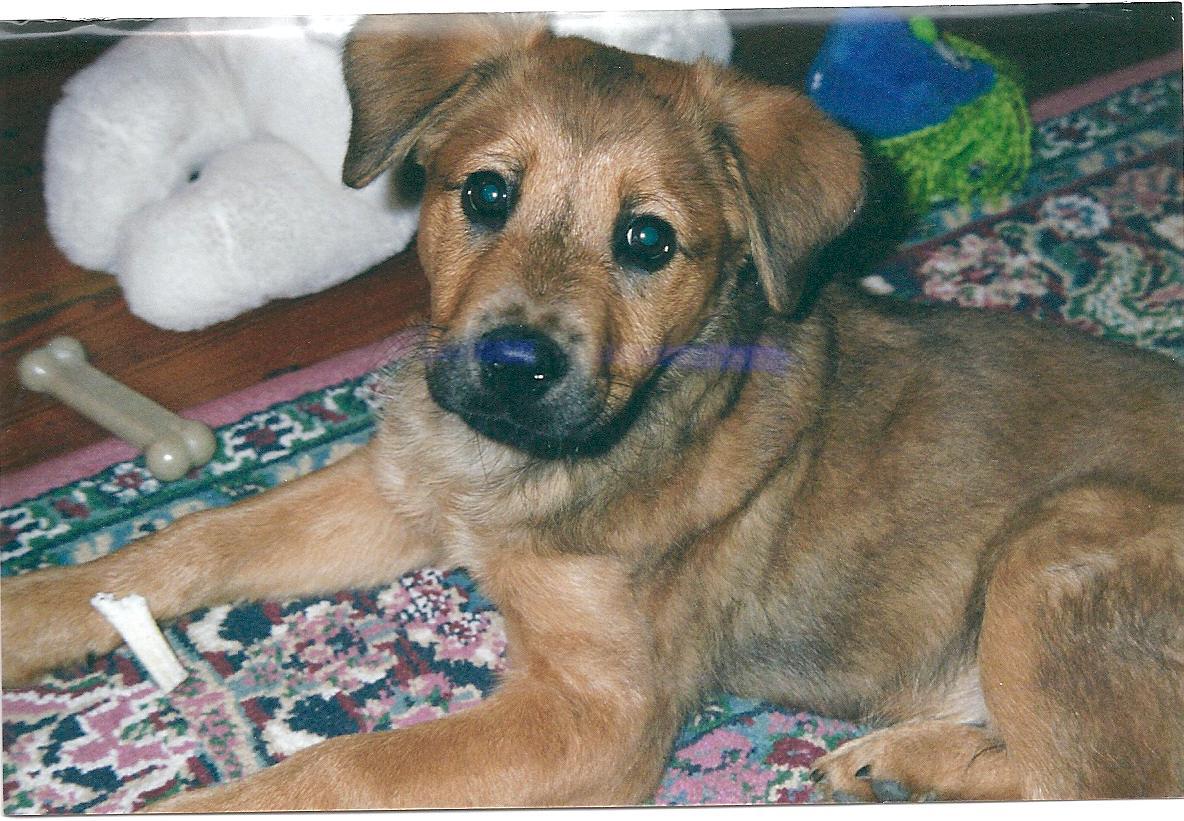
In September of 2000, Gryffin was on death row. I was just too naïve to know it. When I met him at an Atlanta-area shelter, I saw only an adorable 12-week-old puppy awaiting a home. He was black and gold and as friendly and clumsy as most puppies, but compared with his littermates, he was remarkably calm.  His paperwork revealed he was a Retriever/Chow mix; the shelter named him Rebel.  He was irresistible. I called Kevin, who was then my fiancé, and pleaded my case – Rebel’s case. The next day, Gryffin – the dog formerly known as Rebel – came home with me.

Gryffin using a sleeping Kevin as his pillow.

But what if we hadn’t adopted him?  What if no one had? Then Gryffin would likely be dead, because each year in Georgia, more than 80% of dogs and cats at county shelters are killed, an estimated 300,000 animals, at a cost to state taxpayers of $100 million. Pregnant dogs and cats are killed upon drop-off.

“An epidemic is what it is,” says Ginny Millner, one of the founders of Fix Georgia Pets, an organization tackling the crisis of pet overpopulation, and “euthanasia isn’t the answer.”

For those of us living in the Northeast and on the West Coast, spaying and neutering dogs is common.  In fact, Nora Parker, at New Jersey’s St. Hubert’s Animal Welfare Center, says it’s rare for dogs dropped off at its shelters not to be fixed.

That’s not the case across much of the South, where attitudes about dogs reflect the region’s rural and agrarian history. “People thought of dogs as animals, not pets,” says a good friend raised on a ten-acre farm in north Georgia. “A pet is something you care for. It lives inside the house; it is a companion.” Growing up, she says, people had “yard dogs” for protection. “If they didn’t protect your house they weren’t any good.” Healthcare for a dog, including spaying and neutering, was unthinkable.  “People didn’t have extra money to spend on their kids, forget their dogs,” she says. So dogs lived outside the house, roaming freely, procreating at will.

Unfortunately today, much remains the same throughout large swaths of the South, resulting in females birthing litters that give rise to more litters.  The numbers are so great that the ASPCA reports that “areas of the south are overwhelmed with more dogs than loving homes.”  That’s why several rescue groups in the Northeast pull dogs from southern shelters, usually just days before the dogs are scheduled to be killed.

But rescue isn’t the solution, according to Ginny Millner, and no one in rescue disagrees. The term “band-aid” is bandied around a lot when talk turns to rescue. The solution – and the challenge – is getting dogs spayed and neutered.

Fix Georgia Pets, founded in March, is a non-profit organization devoted to raising awareness about responsible pet ownership and providing grants to clinics and organizations that provide low- and no-cost spay and neuter services to Georgia residents. Its goal:  raise $5 million dollars to spay and neuter 100,000 animals in the next two years.

“It’s got to be done and it’s got to be done soon,” says Ginny Millner, “because the more you wait, the more animals you have.” And that means more animals living on deathrow.

Gryffin, about four months old: spoiled, happy and very much loved.

***

Ginny Millner hopes Fix Georgia Pets will be a model replicated throughout the South. To learn more, go to www.fixgeorgiapets.org.

Killer Instinct: Update

The post Killer Instinct offered a window into Galen’s personality.  For those who haven’t read it, Galen is the dog that sits on our deck and watches groundhogs feast on whatever it is they find edible in our backyard. My previous dog, Gryffin, was a hunter who viewed groundhogs (and rabbits, squirrels, deer, birds…) as the enemy, invaders to be vanquished from his soil.

The other day, very much out of character, Galen took off after a large grey groundhog just a couple of feet from our shed. Before I could scream for the groundhog to run – I was afraid what it might do to Galen, an Aussie/lab mix that is more herder than hunter, more lover than fighter – Galen tackled the critter.

I don’t know which animal was more stunned.  Galen steamrolled right over the groundhog and kept running.  No killer, she; though, she might make a great linebacker. The groundhog lay motionless before righting itself and scurrying under the shed.

I have to believe pure animal instinct sent Galen sprinting toward the groundhog.  But the entirety of her action confirmed what I already knew:  the groundhogs that venture into our yard are safe under her watch. They might get the wind knocked out of them, but they’ll live.

Quote of the day

I can’t count the number of times that the happiness of a dog has flowed in my direction, but it’s one of the reasons I have dogs.  Surely, it’s one of the reasons we all have dogs. We don’t spend nine billion dollars a year on dog food just to have dog hair all over our couches.

 — Patricia B. McConnell, Ph.D., For the Love of a Dog: Understanding Emotion in You and Your Best Friend

No Go

When you adopt a dog, you and the dog form a unique understanding. You will walk the dog, because dogs demand exercise, and the dog will walk, thus ensuring that you, too, get a work-out. In a country with ever-increasing obesity rates and a down economy, dog walking is a win-win for your body and your bank account – no costly gym membership required.

Unfortunately for me, my dog, Galen, may be the only dog on this earth that does not enjoy going for a walk. There may be some toy breeds that dislike walking because their little legs can’t keep pace with their humans (not being a veterinarian, this is pure speculation), but Galen is a 21-month-old, 60-pound black lab/Australian shepherd mix. She is rife with energy (and she has long legs).

The day we adopted Galen, I carried the tiny eight-week-old pup out of the Agway Garden Center where she, her siblings and several cats were up for adoption. I set her down in the parking lot, snapped on her leash and headed to the car.  Galen didn’t follow; she simply sat down.  No problem, I thought, too young to walk on a leash.

As the weeks and months passed, little changed.  I would attach Galen’s leash to her collar, get halfway down the driveway… and she would sit down.  This tendency toward being a homebody was a blessing when she was loose in the yard, but frustrating when I wanted to walk.

My vet counseled me to take the reins of our relationship.  And I did.  But our walks weren’t very pleasant.  We’d walk a few yards, Galen would sit, I would tug, and we’d walk a few yards, Galen would sit, I would tug, and we’d walk a few yards… I was not burning many calories, and she was not releasing any of the puppy energy she was using to terrorize my children.  (More on Galen the Terror when I write the forthcoming post: Daycare Saved My Marriage.)

One day, rather than a forced march through the neighborhood, I decided we would walk to the horse farm down the road.  My previous dog, Gryffin, loved taking that walk with me.  Galen and I barely got a quarter of the way to the stable when she didn’t simply sit down; she turned her body toward home and lay down. I waved the white flag. If this was a battle over who was more stubborn, she was clearly winning.

On our retreat home, we passed a cow pasture. This day, a very large brown and white cow was nestled up against the fence which stands about a foot from the road. As Galen and I approached, the cow turned its massive head toward us and mooed.  Galen froze. No amount of pulling or prodding would move that dog forward. I had to pick her up – by now she weighed more than 40 pounds – and carry her home.

Of course, I could strap on my iPod and walk by myself. Lots of people who don’t own dogs do just that. But when you have a dog, you have an understanding:  you no longer need to walk alone. You get to go with a friend. Unless your friend is Galen.

***

Galen in the Sourland Mountains.

 My family has learned that although Galen does not like walking on a leash, she does enjoy hiking off one. In fact, she’s a pleasure to hike with, because she doesn’t stray from us or the path.

She simply leads the way.

Killer Instinct

It’s been almost two years since Gryffin died, yet not a day goes by that I don’t think of him or speak of him. And it’s all Galen’s fault.

The other day, I sat at my kitchen island staring out the window when I noticed a large brown groundhog in the middle of the backyard. It stood on its haunches surveying its surroundings, lowered to the ground, and shuffled toward the house. Then it did it again, and again. I knew Galen was outside, so I got up to look for her.

I knew if Gryffin were still around that groundhog would be a goner.  Gryffin did not allow critters of any kind to invade his terrain.  He’d been known to kill baby bunnies too young and too slow to hop to safety on the other side of our invisible dog fence.  And more than once he got his snout bloodied trying to root out groundhogs from under our shed.

Gryffin, the hunter.

About four years ago, I came home to a stand-off between Gryffin and an exceptionally large groundhog. It was unusual for Gryffin not to greet me in the driveway, so I called his name and scanned the backyard – it’s about the size of one-and-a-half football fields with an island of trees and bushes at the 50-yard-line. I heard an awful hiss. Behind the island, I saw Gryffin and a groundhog in a nasty stand-off. Gryffin was leaning toward the groundhog, barking, devising his plan of attack; the groundhog stood tall, hissing, searching for an escape route.  I ran toward them, screaming, “Gryffin, come!”  He didn’t. I don’t remember how, exactly, I broke up that fight, but I did, and both animals retreated unharmed. I like to think Gryffin would have been the victor had they fought, but groundhogs are ruthless.

I found Galen on our deck, lying in the sun and watching the groundhog. I know Galen saw it, because her eyes were tracking its movement toward the house. I’ve seen her sit on the deck and watch deer traverse the yard.  Sometimes she watches the rabbits, but usually she chases those. She chases birds, too. And I have seen her run after groundhogs that were too far away — despite her incredible speed – for her to catch. She’s brave in the, “I can be brave when I know you can’t hurt me” kind of way. I yelled at the groundhog, sending it scurrying to safe haven under the shed.  If Galen had decided to take it on, I would have put my money on the groundhog.

Galen, a lover, not a fighter.

My little girl doesn’t have the killer instinct her brother had.

No matter what Galen does – or doesn’t do – I’m always comparing her to Gryffin. In living with her and loving her, she keeps Gryffin alive.

Mission: Adoption

Fostering a puppy is not easy.

It’s not simply that you must live in a state of constant vigilance to ensure the puppy doesn’t act, well, like a puppy, by peeing on your kitchen floor, chewing up your favorite shoe, or escaping into the neighbor’s yard. What makes fostering a puppy so difficult is that you can’t unplug your heart.

Loki

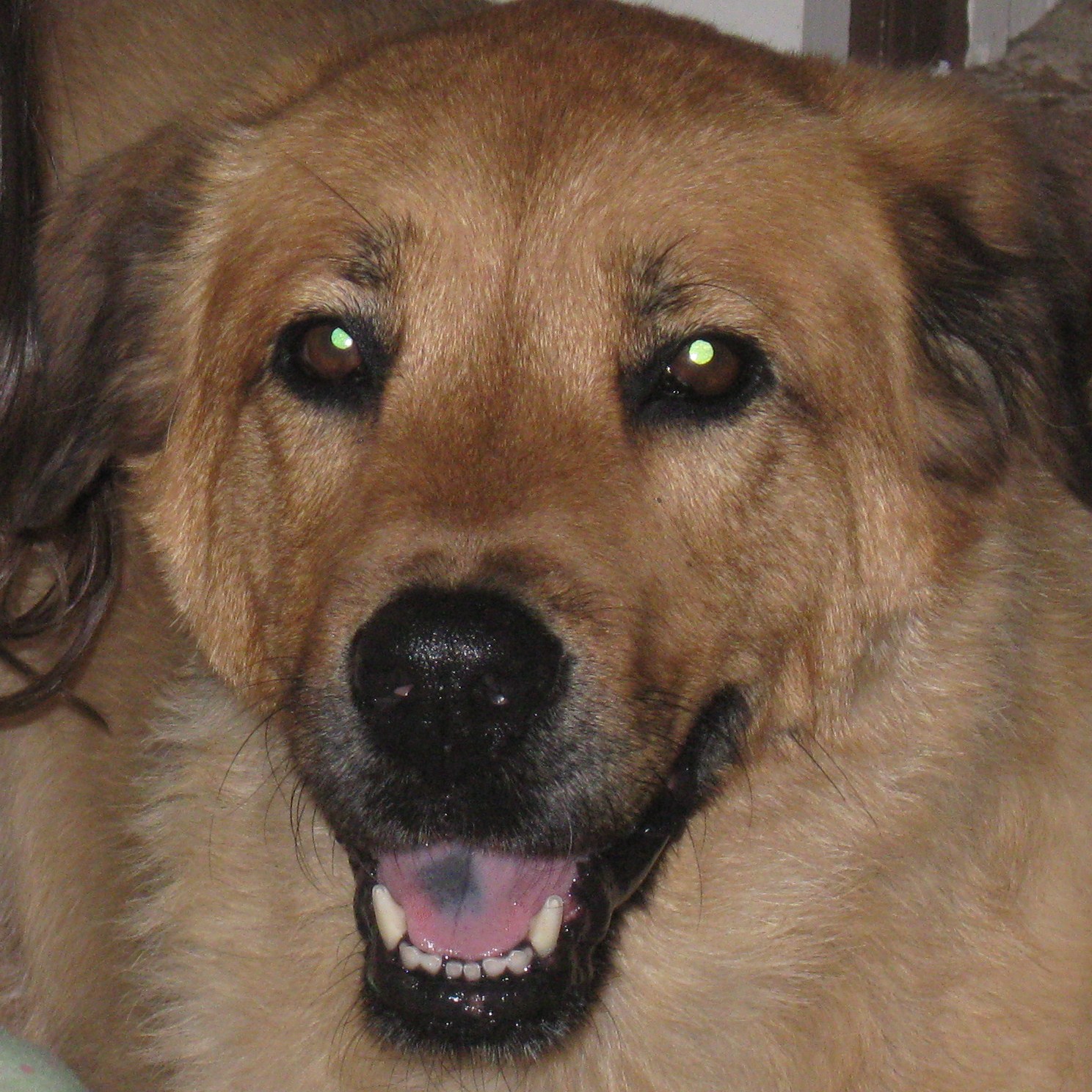
I feel like we’ve known Loki for months, yet he’s been in our lives just over two weeks.  My husband, Kevin, and my two daughters saw something special in the six-month-old pup, when we met him June 16, at a local Pet Valu. He’d been rescued from a North Carolina kill shelter and brought to New Jersey by Catnip Friends Cat Rescue, but the group wasn’t having success finding him a home. We agreed to foster him, while Catnip sought someone to adopt him.

I quickly came to realize, however, that my daughters, ages 9 and 7, wanted to make Loki a part of our family. Kevin seemed amenable, as did Galen, our 20-month-old lab mix, also a Catnip rescue.  I watched Galen quickly move from indifference to joy at having a playmate at her beck and call. She didn’t even seem to mind that Loki stole every one of her toys, including the Mickey Mouse with whom she shares her crate (Mickey makes a great pillow for a dog’s weary head).

Galen and Mickey Mouse.

I was the lone hold-out, unsure that our house was large enough for two dogs, even if our hearts were.

A few days into Loki’s stay, I engineered a solution that works for me and that my girls, despite tears, are learning to live with: My mom and stepdad adopted Loki. The thing is, there was no way I could return him to the rescue group; he had already been through so much.  Just a month before we brought him home, Animal Control was set to kill him.  It says so right on his intake form: “Release Date 05/15/2012.”  “Release” is a euphemism for euthanasia.

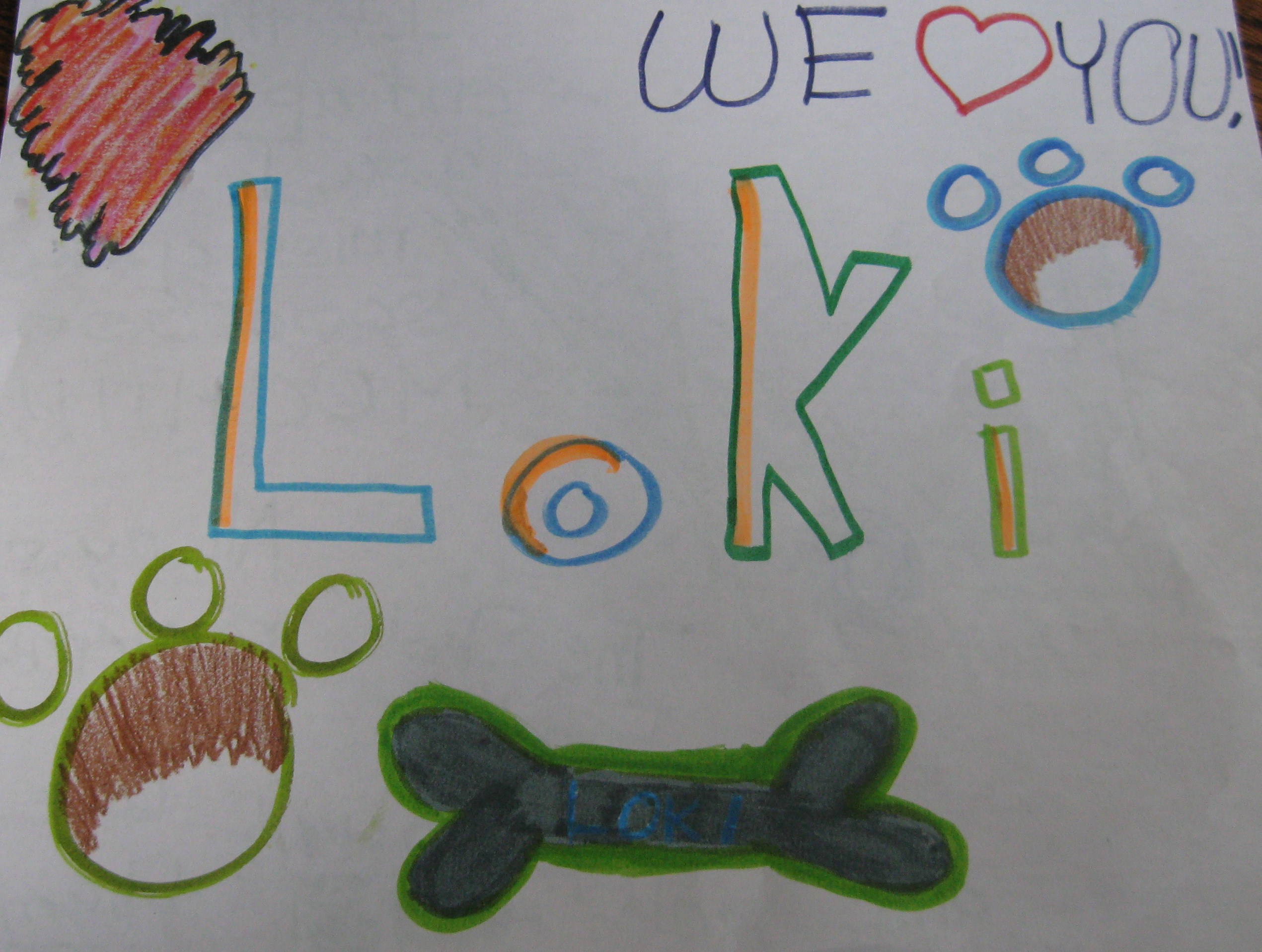
My seven-year-old has taken the decision hardest.  She drew Loki a card.  It reads, “If they end up keeping you, I’ll miss you sooooooo MUCH!!!!! Always remember us.  Love, the Skole family.”  

Dhani’s letter.

***

Loki seems very happy in his new home.  He has a large tree-filled yard to romp in, lots of sticks to chew on, and my mom is already spoiling him: In the evening, Loki settles into a prime spot on the couch right next to her.

As for fostering, I am in awe of those who do it.  One of the co-founders of Catnip told me that fosters are the life-blood of a rescue organization.  Perhaps, we’ll try again.  The need for foster families is great.

Quote of the day

In a perfect world, every dog would have a home and every home would have a dog.Author Unknown; on a hand towel at the Ron Jon Surf Shop on Long Beach Island, NJ

We had to have it!

Three for three

We’re three for three:  Three shelter dogs from the south. Three diagnoses of kennel cough and intestinal parasites. Perhaps it’s not fair to blame the dogs’ southern heritage; a study of U.S. shelters by the UC Davis Veterinary School found kennel cough and intestinal parasites are common in shelters in all 50 states. Still, we’re three for three.

Loki is our newest rescue.  He strutted into our lives on Saturday. I intend for our family to foster him for a week; my daughters intend for us to keep him for a lifetime. In truth, he is as well-behaved as he is funny looking, and he’s only about six-months-old. At least that’s how old the vet guesstimated him to be.

Loki, as seen on petfinder.com.

By Monday, I was concerned that Loki might have kennel cough. At first, he seemed to hack only after eating, so Kevin and I attributed the coughing to the fact that he inhales his food more quickly than my vacuum could.  But the hacking turned to honking and retching, so I took him to the vet. Now he and Galen are on Clavamox twice daily.

Galen is no stranger to kennel cough, a highly contagious respiratory disease that, despite her being only 20-months-old, she’s already had twice; she was infected at eight-weeks-old when we adopted her.  According to Petmd a “very high percentage of dogs” will get kennel cough at least once during their lifetime. For Galen, I’m hoping two times doesn’t become three before she reaches her second birthday.

Galen, at 3 mos. old.

If dealing with the kennel cough wasn’t enough, the vet called Thursday to inform me that Loki’s stool tested positive for coccidia, giardia and whipworm, all common intestinal parasites. I rushed to the vet’s office to pick up more meds. My kitchen counter is beginning to resemble a pharmacy.

It’s pretty clear that Loki poses a minor health threat to Galen.  But after an initial period of seeming disinterest, she’s really taking to the little guy.  They fly around the backyard and roll on top of each other, mouths wide open nipping each other’s necks.  I couldn’t keep them apart if I tried.

Perhaps the most significant event of the past several days occurred Wednesday, when we crated Loki for the night.  As in nights past, Kevin ushered Loki into his crate, which sits in our family room, and then he and Galen retired to our second-floor bedroom.  But this night, instead of a few seconds of whimpering followed by silence, Loki cried… loudly, and he didn’t let up.  I shot Kevin a frantic look:  I did not want two dogs in my bedroom!

Galen ran downstairs.  I went from frantic to complete panic – I did not need her making things worse.  Moments later, however, silence. We didn’t hear so much as a peep from Loki.  And at about 11:30, when I like to presume Galen was confident Loki was sleeping, she came back upstairs and stumbled into her own bed.

Thursday night she slept downstairs with Loki.