The Evolution of Brownie to Bella

Naming a dog can cause as much consternation as naming a baby. After all, a name stays with a person – or a dog – for a lifetime (usually).

Last year, the most popular dog names were Bella, Bailey, Max, Lucy, Molly, Buddy, Daisy, Maggie, Charlie, and Sophie, according to VPI, a pet insurance company.  Spot, Rover, and Fido didn’t make the cut.

Giving pets “people” names dates back to the 1960s, but picked up during the 1980s, according to UC Berkeley anthropologist Stanley Brandes, who studied pet naming trends as revealed by gravestones at a pet cemetery outside New York City.  Today’s “pets-with-people-names-craze” as VPI calls it, reflects another evolution of the last several decades: treating dogs as kin.

Prior to World War II, Brandes found that pets rarely shared names with people.  In the first 50 years of the 20th century, stones were engraved with names like Brownie and Boogle, Hobo and Jaba, Punch and Pippie.

Kevin and I named our first dog – who we’ve always considered our first child – Gryffin.  We wanted a unique name that would have special meaning for us.  At the time I was reading the Harry Potter series on Kevin’s recommendation, so we looked to the boy wizard for inspiration.  Harry, we agreed, was too blatant a choice; Gryffin, short for Gryffindor, now that had a nice ring.

When we adopted Galen after Gryffin died, we turned to religion for inspiration.  In Judaism it is customary to name a baby after a relative who has passed away – it is said this keeps the person’s memory alive, and in a metaphysical way forms a bond between the soul of the newborn and of the deceased family member. It was a given for us that our new pup would be named after Gryffin. Going through “G” names we came upon “Galen,” the name belonging to an Ancient Greek physician.  As Kevin is a doctor, “Galen” held a welcome secondary meaning.  Then a web search revealed Galen means “calm,” which is, of course, the canine temperament we were hoping for in our new dog.

What I didn’t know when choosing Galen’s name or Gryffin’s, is that there are rules for naming dogs proffered by people reporter Jan Hoffman calls “self-anointed dog-naming experts.” Hoffman’s story in today’s New York Times recounts her family’s quest to find the perfect name for their Havanese.  Most interesting to me was the advice she got from the Monks of New Skete:  “Avoid human names.”  People who don’t, the monks say, tend to anthropomorphize their pets.

Hmmm.  Based on those popular dog names, there’s a lot of anthropomorphizing going on in America these days.

***

George Washington owned a dog named Lady. Abraham Lincoln owned a dog named Fido.

The monks would have approved.
Life and Death Decisions… Daily

Imagine: You are the director of an animal shelter. During the last week of February, your shelter took in 48 dogs. Now the spring birthing season — when intake numbers traditionally spike — is  upon you. You’ve been working hard to increase the shelter’s adoption rates, but you can’t call the shelter No Kill – not yet, not by a long shot; healthy dogs are still put down daily to make room for those that will inevitably come through the door. Unfortunately, your situation is echoed throughout the United States, primarily in the South, where studies show spay and neuter rates are lower than in any other region. This leads to more dogs having more litters, and that, of course, leads to more crowded shelters.

Now in comes a pregnant stray. Shelter volunteers name her Maple – she’s a friendly retriever mix with red-gold fur and a sweet disposition.

You get that all-too-familiar sick feeling deep in your stomach.

The law prohibits you from adopting out dogs that have not been spayed or neutered.  That means you can’t release Maple unless she is spayed, and spaying will kill her puppies.  If you hold Maple until she births her pups, you will have to kill other dogs to open up space for her litter.

You ask yourself:  Does it make more sense to euthanize puppies yet to be born or to euthanize those that are already living?  The decision is yours; you must make it.

***

In too many shelters across the country, shelter directors make life and death decisions daily.  There is just not enough room in overcrowded shelters to house all the dogs that are picked up as strays or surrendered by their owners.  These are healthy dogs, adoptable dogs, dogs that would make great pets.

Finding homes for the country’s homeless dogs must be a priority, or shelters will continue to use euthanasia to control their populations, and euthanasia due to homelessness will remain the leading cause of canine death in the United States. But as the spring mating season is upon us, there is something dog owners can do to stem the flow of new litters: Spay and neuter your pets, and encourage others to spay and neuter theirs. Veterinarians say you and your pet will reap the benefits:

  • Altered pets live longer, healthier lives. (Females will not get ovarian or uterine cancer; males will not get testicular cancer and are less likely to suffer from prostate disease.)
  • Altered pets are easier to train.
  • Altered pets have less desire to roam, making them less likely to become lost or hit by a car.
  • Altered pets have fewer behavior and temperament problems.
  • Altered pets tend to be less aggressive, yet they remain protective of their families.

***

There is an abundance of information online regarding the reasons to, and the benefits of, spaying and neutering your pet.  Here’s a link to get you started, should you want to learn more:  American Humane Association.

Black is Beautiful

When Kevin and I lived in Philadelphia taking Gryffin to the dog park was a staple of our day.  We met lots of dogs (people, too, of course), but one pup stands out in my mind for her sheer beauty. Athena was a Rottweiler, regal in stature and longer and leaner than the breed standard.  Her coat – glossy black fur patched with gold – wrapped pure muscle.

I thought about Athena when I read an article in Tennessee’s Johnson City Press about a prejudice many people have against large black dogs.  This prejudice keeps black dogs from being adopted from shelters, leading to high euthanasia rates.  The director of the Washington County/Johnson City Animal Shelter told the paper that during times of overcrowding black dogs are first to be killed, because they are less likely to be adopted than their lighter-colored contemporaries.   “People walk past (the black dogs) and don’t even really see them and don’t look at the personality,” she said. “A lot of people think the large black dog … might be menacing. It might be a threat.”

There’s a name for this phenomenon: Big Black Dog Syndrome.

I admit to being a little stunned. I find black dogs beautiful – and also, sensible.  (As someone who wears so much black that I’ve had college students ask me if my wardrobe includes any other color, it would be a pleasure to own a dog whose fur didn’t mar my clothes as Gryffin’s did and Galen’s does.) But apparently, there are those who don’t share my sensibility or my eye for beauty.

Anthropologist Amanda Leonard is the founder of The Black Dog Research Studio and writes about Big Black Dog Syndrome (BBDS), which she defines as “the extreme under-adoption of large black dogs based not on temperament or health, but rather on the confluence of a number of physical and environmental factors such as size, color, the kennel environment, the “genericness” of black dogs, and the Western symbolism of black as representative of evil.” Lest anyone think this is farce, she cites a representative from the Humane Society of the United States who, in 2011, told MSNBC that BBDS “is not a hoax… it is something commonly accepted by shelter workers as truth.”

Recently Petfinder added numbers to the anecdotes.  A survey of its affiliated shelters and rescue groups found that most pets are listed on Petfinder’s website for 12.5 weeks, but less adoptable dogs, which include senior, special needs and black dogs, spend up to four times as long.  And interestingly, BBDS is not breed specific — Labrador Retrievers, Chows, Rottweilers, Pit Bulls, German Shepherds, Newfoundlands and mixes of these breeds are shunned equally.

There is hope that today’s discrimination against big black dogs won’t be tomorrow’s. That’s because Leonard has found that much of the prejudice is unconscious.  Once people are made aware of it, she writes, most move past it.  There are also simple strategies shelters can employ to make black dogs appear less intimidating, like putting a bright-colored bandana on a black dog, and not grouping black dogs together, instead putting them in runs beside lighter-colored canines.

In the 1960s, a group of African-American artists, musicians and writers launched a cultural movement called Black is Beautiful to challenge European aesthetics of beauty and to dispel notions that blackness in skin color, facial features and hair is inherently ugly.  Animal welfare advocates should embrace this mantra as well.

Black is Beautiful… on people and dogs.

Grab a tissue… or two, or three

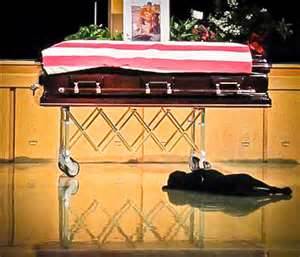
You’ve probably seen the heartrending photo of a Labrador retriever lying in front of his owner’s flag-draped casket. If not, here it is:

casket

The dog is Hawkeye; his owner, a Navy SEAL, was killed in Afghanistan in August 2011, when a rocket-propelled grenade hit his Chinook helicopter. The photo – and the story – went viral as an iconic depiction of the profound bond between people and their pets.

Now comes Tommy, a seven-year-old German shepherd in San Donaci, Italy, who has been attending mass for the last two months at the church where his owner’s funeral was held and where, before she died, they attended mass together daily.

Tommy in Santa Maria Assunta church

Tommy in Santa Maria Assunta church

You can read the full story here.

But so far as I know, only one dog has been memorialized in bronze for his exceptional loyalty.

In 1924, Hidesaburo Ueno, a professor at Tokyo Imperial University adopted an Akita he named Hachiko. Each morning, dog and owner would walk to Shibuya Station, where Ueno would catch a train to the university.

Each evening, Hachiko would return to the station to welcome the professor home. But on May 21, 1925, Ueno didn’t return; he’d died after suffering a stroke during a faculty meeting. From that night on, for nearly ten years, Hachiko returned to the station at precisely the time Ueno’s train was due to arrive.

A newspaper story about the loyal Akita lured people from all over Japan to visit him. In 1934, a bronze statue of Hachiko was erected in front of the station’s ticket gate with the dog on hand for its unveiling. During World War II, the Japanese melted the statue to use its bronze for the war effort, but in 1948, the original sculptor’s son created a replica, which still stands today. The statue is said to be one of the most popular meeting places in all of Tokyo.

Hachko's statue in Shibuya Station

Hachko’s statue in Shibuya Station

Hollywood knows a good story when it hears one, and Hachiko’s was too good to pass up. Thus:  Hachi: A Dog’s Tale, A True Story of Faith, Devotion and Undying Love hit U.S. theaters in 2009. The story is true only in the Hollywood sense; produced for an American audience, it is set in a quaint New England town, and the professor is played by a very handsome Richard Gere. Joan Allen is Gere’s wife, and Jason Alexander is Carl, the train station attendant. My family rented the movie a couple of years ago and cuddled on the couch to watch it, without any notion of its Japanese roots.

Reading about Tommy started me thinking about Hachi, the movie, and then Hachiko, the dog. And then I thought about my dogs. For me, Galen is more than a companion or a best friend – she is a deeply loved member of my family, as was Gryffin before her. I’m not alone in my thinking. A 2011 Harris poll found 92% of dog owners considered their pooch part of their family.

Back to Hachi:  The movie is definitely worth watching.  Just be sure to grab a tissue… or two, or three.

Actually, grab a whole box. If you’re anything like me, you’ll need it!

***

I can still see my first dog. For six years he met me at the same place after school and convoyed me home—a service he thought up himself. A boy doesn’t forget that sort of association.

– E.B. White, author of Charlotte’s Web and Trumpet of the Swan

They think, therefore they are

One of my favorite and most difficult courses in high school was AP Social Studies with Mr. Grasso. He introduced me to philosophy, and if not for his class, I’m not sure I would have gotten through the one philosophy course I took in college. Some of his teachings have even stayed with me after all these years, like Rene Descartes’ “Cogito ergo sum“ – “I think, therefore I am.”

I came across Descartes again recently, in an unlikely place.  I was reading Patricia McConnell’s For the Love of a Dog: Understanding Emotion in You and Your Best Friend. It turns out that Descartes, the French philosopher, mathematician, and writer regarded as the Father of Modern Philosophy, was a dog killer.  Descartes believed that dogs did not have the capacity to think, that they had no emotions and no feeling, even for pain.  McConnell writes:

[Descartes] illustrated this principle by nailing live dogs to barn walls and eviscerating them. While the dogs writhed and screamed, he told the crowd of onlookers that their struggles were merely automatic movements of the body – no more felt by the dog than a clock feels the movement of its hands.

Wow.

McConnell points out that as recently as 1989, educated folks shared Descartes’ crazy ideas. One philosopher she cites argues that because dogs can’t feel anything “concern about them is unethical, because it takes time and money away from helping humans.”

Again: Wow.

I hope anyone who’s spent any time with a dog would see the outrageousness of all this. On a daily basis I see the wheels in Galen’s head spinning (though my husband will often point out that at times they spin quite slowly). Case in point:  A couple of weeks ago, I walked into our laundry room, which doubles as a mud room, and began lacing up my sneakers. Galen followed, and  upon seeing the sneakers started wagging her tail and smiling, as she presumed we were either going for a walk or heading to the backyard to play with her favorite purple ball. Unfortunately for her – and for me – my destination was the supermarket. When I told her so, her tail quit wagging and her expression turned from expectantly happy to sad, leaving me guilty and wondering, “Couldn’t I have chosen a different pair of shoes?”

Galen’s connecting a walk with my sneakers could have been more Pavlovian than intellectual, but the only explanation I have for why her tail wagging stopped and her face fell when I told her she wasn’t coming with me is that she understood.

Fortunately, anecdotes such as this – that point to an intellectual capacity in canines or a thought process of some kind – are starting to have the support of science and scientists who study human and canine brain structure and brain chemistry. It’s just too bad the science wasn’t there for Descartes. Then he could have extended his cogito to canines:  They think, therefore they are, and taken a dog or two as a pet rather than using them for sadistic experimentation.  

Galen

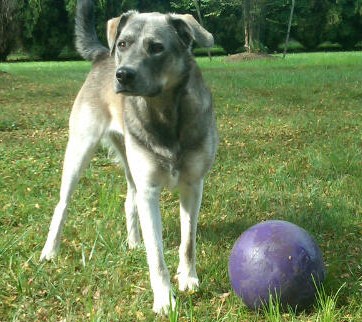
Galen, with her favorite ball. Despite others littering our yard, she will play with no other.

Dogs aren’t the only ones to drop the ball

Albuquerque, New Mexico has a puppy problem. In December, city shelters took in 347 abandoned or surrendered puppies. That number, of course, doesn’t include all the adult dogs that also entered the shelter that month. So what will become of all these potential pets? The shelters and rescue groups will do their best to adopt them out. But the reality is that a number of the dogs – and puppies – will be killed.

According to the city’s Animal Welfare Department, “Every year, thousands of kittens and puppies are born into short lives of suffering and death in Albuquerque because people did not spay or neuter their pets. There are simply not enough homes for the animals that are born because of this type of neglect.”

This “neglect” is certainly not unique to residents of Albuquerque; all over the country there are people who find one reason or another not to spay or neuter their pet. But the city is launching a campaign it hopes will result in fewer litters. The campaign is one part media blitz – public service announcements, banners on buses, and water bill inserts will proclaim the import of spaying and neutering – and one part action – the Animal Welfare Department will offer free and low-cost surgeries to low- and moderate-income residents.

I learned about the public service announcement via a KOAT-TV news story on the web. I love the PSA. I dislike the news story.

First, the PSA. The idea behind it: If you think an unintended pregnancy is a serious problem for you, you should know it’s just as serious for your pet – and its offspring. In one scene a good-looking young couple sits at a kitchen table with an open pregnancy test in front of them.

Woman: I can’t believe this is happening.
Man: It was your responsibility.
Woman: I should have gotten her spayed when I had the chance.
Cue the cat: It jumps onto the table and meows loudly.

In another scene a man is watching TV when the phone rings. Upon answering it he hears a male voice yell, “Your boy got my girl pregnant!” The “boy” is the handsome husky viewers see chewing a bone on the couch. “I knew I should have gotten you neutered,” the man says to his dog.

It’s a great ad: Hopefully the humor will get people watching and the message will get people acting.

Now to the news story, which you can watch here. It got my journalism hackles up for two reasons. First, the light, fun tone of the story belies the seriousness of the issue it’s covering. For example, the reporter leads into her story saying of the city’s problem, it’s “a cute one.” Second, and this is really what’s most significant, is nowhere in the news story does the reporter explain the tragic consequences of pet overpopulation. It’s not crowded shelters, as mentioned in the piece. It’s the unnecessary euthanizing of healthy animals. This fact – perhaps the most important in a story about pet overpopulation – was completely left out.

What do you think? Am I critiquing this story through an advocate’s eyes rather than a journalist’s? I don’t think so. What I do think is that the city of Albuquerque deserves kudos for its campaign. As for KOAT-TV, it dropped the ball on a very important story.

Did you pet a dog today?

The horrific tragedy in Newtown, Connecticut, that took the lives of twenty children and six educators, has families hugging one another a little tighter, and pundits and politicians talking (again) about guns, mental health issues, and media violence.  In the midst of all the news coverage, however, was a story you may have missed, about a special group of dogs and their visit to Newtown.

Lutheran Church Charities photo

Lutheran Church Charities photo

Barnabas, Chewie, Chloe, Hannah, Luther, Prince, Ruthie and Shami – all golden retrievers from the Chicago area – are comfort dogs with Lutheran Church Charities. The day after Adam Lanza’s rampage through Sandy Hook Elementary School, the dogs traveled to Newtown to do what they’ve been trained to do: comfort the bereaved and grief-stricken.  They do their job well.

According to the Chicago Tribune, Lutheran Church Charities launched its comfort dog initiative in 2008, after a gunman killed five students on the campus of Northern Illinois University.  Just this past October, the group’s dogs were not far from my New Jersey home, comforting those whose homes and lives were devastated by Superstorm Sandy.

After my dad passed away a few weeks ago, I found myself sitting with Galen and petting her.  The activity had a meditative quality to it, at once both relaxing and rejuvenating. Usually I walk by Galen and simply give her fur a quick brush of my hand – I’m busy with kids, job, running a household; at night, though, I usually do take a few seconds to pet her as a means of winding down my day.

I’m not surprised about the increasing use of dogs to console people in times of tragedy or simply times of stress.  After all, therapy dogs have long brought comfort to people in nursing homes and hospitals.  Just last week, the owner of the daycare center I take Galen to suggested I train her to be a therapy dog.  “Galen has just the right temperament,” she said.  (I’m adding Galen’s training to my ever-growing To Do List.)

Recently there has been a spate of news stories about universities from coast to coast bringing dogs on campus to help students deal with the anxiety that can accompany final exams.  The Huffington Post even reports that Harvard Medical School and Yale Law School have resident therapy dogs in their libraries that can be “borrowed through the card catalog just like a book.”

There’s science to back up why petting Galen lifted my spirits, and why Lutheran Church Charities has seen its comfort dog initiative grow to sixty dogs in six states to meet demand.  According to WebMD, it takes spending only 15 to 30 minutes with a dog to feel less anxious and less stressed.  That’s because in that short time with the dog, the level of cortisol, a stress hormone, goes down, and the level of serotonin, a neurotransmitter associated with feelings of well-being and happiness, goes up.

Perhaps a take-away here is that whenever we need a pick-me-up, be it because of a minor stress or a life-altering tragedy, man’s best friend can also be man’s best medicine.  I’m not naïve enough to think that in times of tragedy hugging a dog will turn everything right.  But thank goodness tragedies are rare; feeling stressed out is not.  So when you are stressed, you might ask yourself, “Did I pet a dog today?”  If you didn’t, add that to your To Do List.

***

In our social media age, perhaps it shouldn’t come as a surprise that Barnabas, Chewie, Chloe, Hannah, Luther, Prince, Ruthie, Shami and their fellow comfort dogs have their own Facebook page, Twitter account and email, so they can keep in touch with people they meet.  Each dog also carries an old-fashioned business card.  (Thanks to the Chicago Tribune for these fun facts.)

A Simile I Can Believe In

“Dogs are like tattoos.

Ask folks about their tattoos and they can tell you exactly what was going on in their lives when they got them, how the idea came to them, why it seemed, at the time, a good thing to do… They mark their owners permanently with a visual memorial of the past.  Like dogs do.

I’ve never had a tattoo, but I’ve had many dogs, and all of them have left their own indelible marks on me.”

I wish I could take credit for that passage, but those words belong to Ken Foster and are from his book The Dogs Who Found Me:  What I’ve Learned From Pets Who Were Left Behind.  It’s a compelling story about a man who had the misfortune to be living in downtown New York City on 9/11 and in New Orleans during Katrina, and the dogs who found him during those in-between years.

When I read the passage I had to put down the book and contemplate the three dogs that have graced my life:

  • Sammie, a West Highland White Terrier, who joined my family when I was thirteen.  She was a peace offering from my parents who had just announced they were splitting up.  It was sort of like, “On the downside, your parents are getting divorced, but on the upside you are finally getting that dog you’ve always wanted.” (Apologies to mom and dad if that’s not the message you intended to send.)
  • Gryffin, a Retriever-Chow mix I adopted from the Humane Society in Georgia, when I was living in Philadelphia but working for a company in Atlanta. My girlfriend had adopted Gryffin’s brother and was crusading to save the entire litter. In uncharacteristically spontaneous fashion – I am one of the least spontaneous people you will ever meet – I quickly got okays from my fiancé, from Delta airlines (to let the puppy fly coach with me to Philly), and from the Humane Society (which had to approve my adoption request). It was the best, if only, spontaneous decision I’ve ever made.
  • Galen, a Labrador retriever-Australian shepherd mix my husband and I adopted just two months after Gryffin’s death.  We had planned to wait to adopt another dog, but the emptiness in our house was too much for me to bear.  So with heavy hearts and plenty of urging from our two daughters, we showed up at a local rescue group’s adoption day. That’s where Galen squirmed her cute little puppy self into Kevin’s heart. I had assumed we were looking for a male to replace Gryffin and to even out the uneven gender ratio in our home (one Kevin to three females), but Galen had him hooked.  She still does.

I’ll have to ask my friend Shari about the indelible marks her dogs have left on her.  When I met Shari in Atlanta, she was living with Hank and Lou and at least one cat.  These days she lives in New Jersey, and while Hank and Lou past before she made the journey north, she did bring along Penny.

Little Miss Penny

Penny is a princess with a mean streak who keeps her recently adopted brother, Calvin, in line.

Calvin

Both Penny and Calvin are rescues.

If you own or have ever owned a dog, I hope Foster’s words inspire you to take a walk down memory lane… with your dog, of course.

***

If you rescued a dog (or dogs), send me a picture (or two). I’ll post the pictures on shesadork.com. And if you have a story to tell about your dog, send that along, too. –Jacki

Dogs are Teachers, Too

I never stop being amazed at how many people I meet in the Northeast who have made a dog from the South a member of their family.  And now I know someone for whom one just wasn’t enough.

I’m taking an online non-fiction book writing course, and it is through this course that I met Loren.  We have much in common: a background in television, a yearning to write a book, and a love of dogs, but where as I have only one canine companion, Loren has three.  They are her children.

I’ve said many times that my first dog, Gryffin, prepared me for motherhood, and I believe that Galen, in all her quirkiness, is inspiring me to write. Loren — in her introduction to our classmates — noted that despite having both graduate and undergraduate degrees, “My dogs have taught me more than I learned in college.”  Amen.

Here are pictures of Loren’s beautiful dogs.

Orry

Orry Maine, a Tennesee native.

“He was named “Monty” which he clearly had no interest in acknowledging, and we played Rumplestiltskin until he perked up at this most unlikely choice.  Not sure why absolutely no one remembers this, but it was the name of Patrick Swayze’s charter in North and South, which seemed very appropriate.”    -Loren

Stella


Stella, from Alexandria, Louisiana.

Pete


Pete, from Austin, Texas. “The product of the best rescue we have encountered.” -Loren

Orry and Stella

“They blend together so well that it is impossible to imagine them existing apart.  This morning, they were laying side by side and I saw Orry casually put his arm over his sister’s back, where it lay for another fifteen minutes of sleep. The magic of rescue.” -Loren

If you rescued a southern pup, send me a picture (or two).  I’ll post the pictures of your pooch, too. -Jacki