Miss Independent

My little girl is growing up.  Yes, it’s totally cliché – bad when voiced and worse when written, but it’s true. Galen will turn two in October, and according to the famed Dog Whisperer, Cesar Milan, that means she’s pushing 21.

A post on Milan’s blog states that the oft-cited “multiply by seven” rule to determine a dog’s age is a myth. Apparently, dogs mature fastest in their first two years and then age an average of four human years each year thereafter.  Admittedly, I was one of the misguided. I thought Galen was just now entering her teen years, but apparently we’ve already lived through them. I can only hope that when my human daughters reach those potentially tumultuous years that they navigate them with as much grace and as little drama as Galen did.

Galen’s physical size exploded seemingly overnight.  It shouldn’t have come as a surprise – all large dogs grow quickly – but still, the transformation from soft, sweet-smelling puppy to full-grown dog happened much too fast.

Galen entered our lives at eight weeks old, the size of an adult Chihuahua, and in less than nine months she was pushing 50 pounds, her legs had grown long and slender, her snout pushed forward, and her blue merle coat had lightened. I love that the bronze fur that topped her floppy ears as a puppy still covers them today.

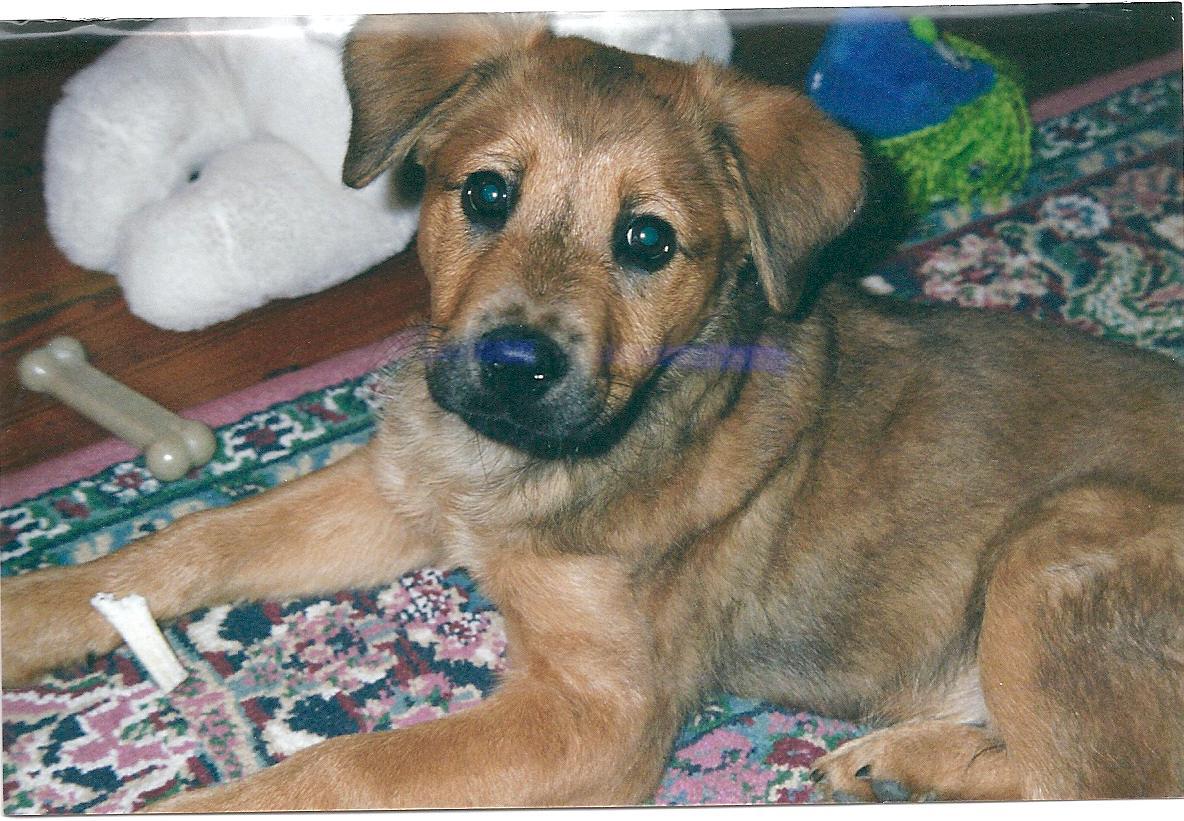
Galen, about 13 weeks old, on the two-inch thick dog bed in our kitchen.

However, the biggest change from Galen then to Galen now is in her personality. She came to us so needy. I spent a good many hours over the course of a good many weeks sitting on a two-inch thick dog bed on our kitchen’s hardwood floor; Galen would curl up on my lap and gnaw a bone, chew her stuffed hedgehog, or nibble on my fingers with her teeny razor-sharp teeth. She needed human contact in a way that our previous dog, Gryffin, rarely seemed to want. Gryffin had entered our lives as an aloof puppy, and he remained that way his entire life. My husband and I took to calling Galen the anti-Gryffin.

Fast forward 22 months and in many ways Galen has taken on the personality of the brother she never knew. As I write this post, I’d love to say that she is curled up by my feet or sleeping soundly on the rug steps from my desk, a Norman Rockwell vision of the writer and her best friend. But Galen’s nowhere to be seen, because she has decided she is a yard dog. She spends her days sitting on our deck surveying the backyard or lying on the driveway waiting for either the postman – he usually tosses her a treat – or the school bus.

Yet even with this new-found independence, Galen still welcomes the girls home as only the most submissive dog in the world can:  tail wagging, rump pointing to the sky, head reaching to the ground, right ear scraping the driveway, whole body inching forward while sounds that resemble a horse’s whinny escape her mouth.

I don’t expect Galen’s submissive nature to subside in her lifetime, but I am enjoying watching her grow from needy puppy to independent adult. I can’t read her mind – though I attempt to all the time – but I see her autonomy as a sign she’s happy and secure in the love my family has for her. I hope to see a similar arc of growth and confidence take shape in my daughters.

We just have to survive their teenage years.

Louie, Louie

If Louie could talk, perhaps he’d tell us how he and two friends found themselves wandering along Franklin Blvd., the main thoroughfare through Gastonia, North Carolina, on a hot day in August. But since Louie is a dog, unless someone comes forth to claim him, all we know is that Louie is a stray.

Vet techs at Gastonia’s lone low-cost spay-neuter clinic, located on a busy stretch of the thoroughfare, spotted Louie and his two friends, a female Labrador Retriever mix and a male Australian Shepherd mix, navigating their way through parking lots and traffic. Three techs grabbed leashes and corralled the dogs into the safety of the clinic.

That’s where Louie and his friends said their good-byes.

Kathy Cole, a clinic employee and long-time animal advocate, had little trouble persuading Lucky Labs of Charlotte to take Louie’s female friend, and she placed the Aussie with a mixed breed rescue. But she couldn’t find any takers for Louie. Perhaps, she says, that’s because she first identified him as a Chow, a breed with a reputation for being aggressive. Kathy’s since revised her initial assessment and now thinks Louie may be a cattle dog mix, but without DNA testing, there’s no knowing for sure.

Galen

I met Louie when I was in Gaston County researching my own dog’s background. I adopted Galen almost two years ago in New Jersey, but she’s a native Gastonian. She and her siblings were pulled from the county shelter and transported north thanks to two women who devote much of their time and some of their own money to rescuing dogs and cats from kill shelters in the South.  My reporting led me to the clinic, which is the brainchild of the Animal League of Gaston County, a non-profit animal welfare organization.  The group hopes that clinic veterinarians will spay and neuter so many dogs and cats that there will be fewer litters, like Galen’s, that end up in the county’s shelter, where they have a better chance of being killed than adopted.

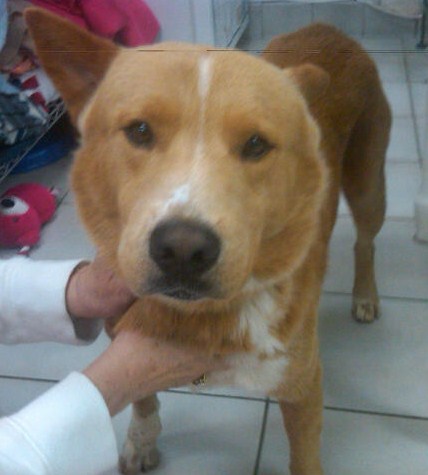
Louie, at the Animal League of Gaston County’s spay/neuter clinic

I’m no dog expert, so I couldn’t add much to the discussion of Louie’s lineage. The color of his thick golden-brown coat is as Chow-like as it is Golden Retriever-like, and he has a big block head with a line of white fur from his forehead to his snout.  His dark eyes lack the sparkle I so often see in Galen’s, and his demeanor is gentle, his facial expression sad.

When I first saw Louie, he was in the rear of the clinic in one of the metal cages that house dogs and cats recuperating from surgery.  The clinic was serving as a temporary shelter, while Kathy and the other vet techs called everyone they knew to find him a foster home.

If I found a stray dog in my central New Jersey neighborhood, I would have no qualms taking him to St. Hubert’s animal shelter. My town outsources animal control work to St. Hubert’s, which is a non-profit animal welfare organization, and I know the folks there would do all they could to find him a good home. First, per New Jersey law, they would hold him for seven days to give his owner time to find him. Then, if no one claimed him, they would put him up for adoption and work tirelessly to find him a forever home.

Kathy Cole won’t turn Louie in to Gaston County Animal Control, because, she says, he will be killed. Unlike St. Hubert’s, the county’s shelter is simply a holding facility and a very crowded one at that. As a stray, Louie would be held for three days, and if no one claimed him, he would likely be killed to make room for newcomers. It wouldn’t matter that Louie is neutered – Kathy had one of the clinic’s veterinarians take care of that – and that Louie has all his vaccinations – she took care of that, too.  In other words, it wouldn’t matter that Louie, who Kathy guesses is about two-and-a-half years old, is a perfectly healthy, adoptable dog.

Perfectly healthy, adoptable dogs are being killed in Gaston County and throughout large swaths of the South because too many people cannot afford to, or will not, spay and neuter their dogs, and too many shelters are not equipped to be adoption centers for reasons ranging from a lack of money and staff, to old and decrepit facilities, to a fatalistic view by some shelter directors that there are simply too many dogs to save.

The good news:  There are people in many of these communities who will no longer accept the killing of healthy animals and who are taking actions to address the problem, people like the folks at the Animal League of Gaston County whose three-year-old clinic has already spayed and neutered more than 10,000 dogs and cats.

***

As I write this post on Sunday afternoon, September 9, Kathy Cole is driving the streets of Gaston County looking for Louie.  She found him a foster home a little over a week ago, but within an hour of being there, Louie jumped the fence and ran away; the foster found Louie sitting under a tree three days later.  Louie returned to the clinic and lived there until Friday, when again, Kathy placed him in a foster home.  Again, Louie stayed an hour before running away. At least now Louie is wearing a dog tag with the animal clinic’s name and phone number, so we can only hope that whoever finds him contacts Kathy, not Animal Control.

If only Louie could talk, he could tell us who he’s looking for and where he wants to go.

The Secret Service Agent and the Spy

If I had to describe Gryffin’s personality in one word, it would be “aloof.” He loved me and Kevin, but he didn’t have much use for anyone else. He lovingly tolerated his human sisters, but when they’d bicker, he’d dart to the sliding glass door in our family room to signal he wanted out. I truly believe he’d have been happy to be an only child.

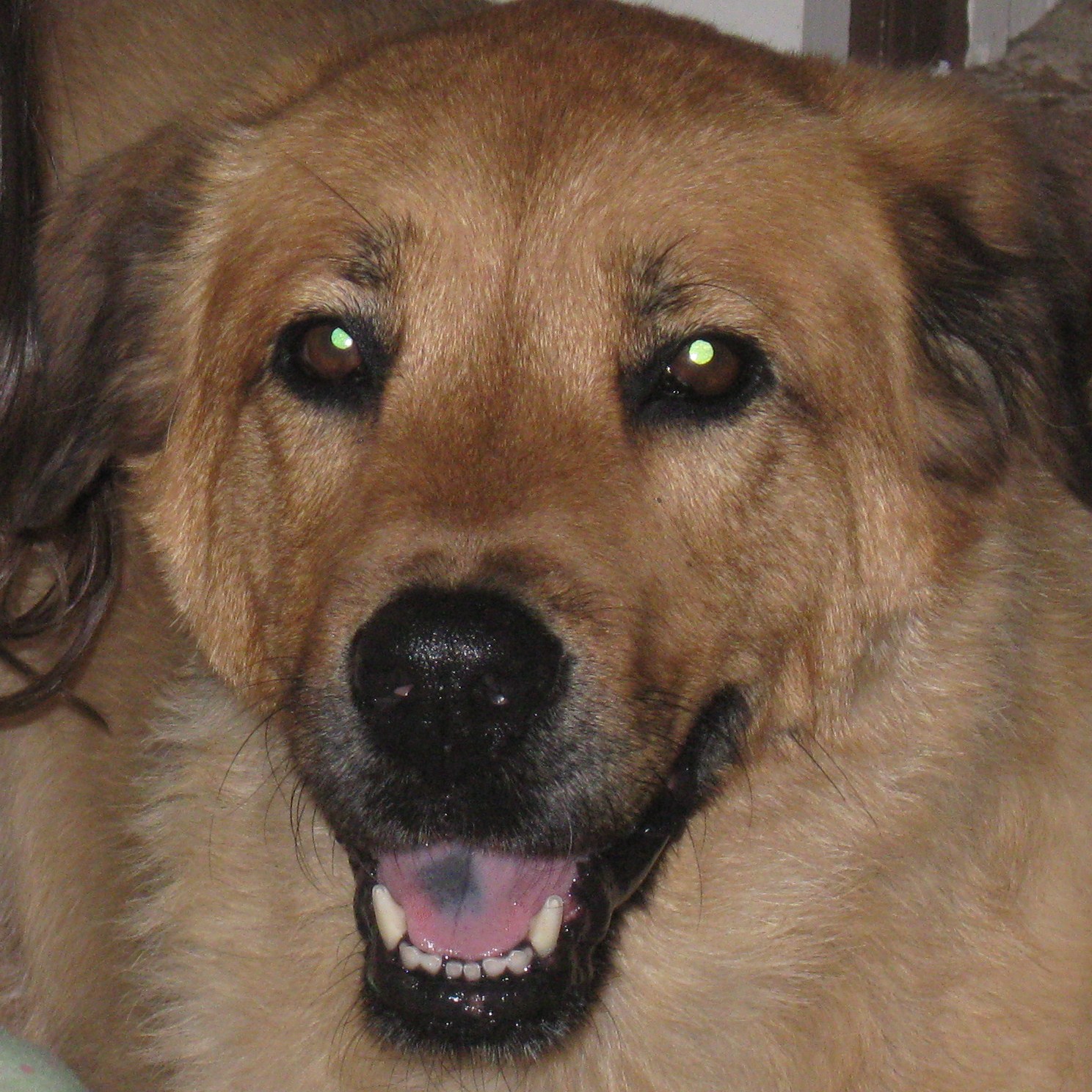
Gryffin

Gryffin was downright rude to strangers. When we lived in Philadelphia, we would walk around Rittenhouse Square, and inevitably someone would stop us to comment on his good looks and ask about his breed.  My answer was always the same: “One hundred per cent pure mutt.” I would add that the shelter we rescued him from told us he was a Retriever-Chow mix. Gryffin’s response to the flattery was most un-dog like: No tail wagging.  No smiling up at the person with wide “please pet me” eyes. No, Gryffin would turn his back to the person, completely uninterested.

After the girls were born, I started calling Gryffin our Secret Service agent because he was always near us, just not next to us. He wasn’t one for cuddling, except for rare occasions early in the morning.  And sometimes the vibe you’d get when you’d sit on the floor next to him wanting to give him some love, was that he’d just as soon be left alone.  But he always had our back. In fact, we never installed an alarm system in our Philly home; we had Gryffin – loyal, loving and always on guard. Perhaps that was the Chow in him.

Galen, our Aussie/Lab rescue, wouldn’t make it in the Secret Service.  She’s more like a KGB spy.

Galen slinks around the house.  Her head hangs lower than her body, and her big brown eyes emanate guilt, like she’s done something wrong. She moves from room to room doing her darnedest to avoid our hardwood floors, so she takes circuitous routes determined by the layout of our area rugs. She never enters the kitchen.

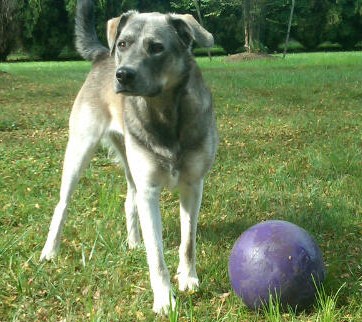
Galen

Galen

Then there’s her unfounded suspicion that I’ve done something nefarious to her food. Every morning and night I fill her bowl with kibble and carry it outside – one of her many quirks is that she doesn’t like eating in the house; she prefers al fresco dining on our deck. (She even eats outside when it’s raining – her choice, not mine.) After I put her bowl down, she slowly backs away and looks at me. I put a single piece of kibble between my thumb and forefinger and hold it out for her to sniff. Ultimately, she takes it; then she stands beside her bowl and waits for me to leave.  She doesn’t like being watched while she eats.

We go through the same ridiculous routine when I buy new dog treats. She gingerly takes one from my hand only after she sniffs it, and it passes whatever test she’s putting it through.

I’ve long wondered what shaped Gryffin’s and Galen’s distinct personalities.  Is it the breeds that combined to make up their doggie selves?  Did being separated from their mothers when they were just weeks old impact their infant psyches? Did being raised by me and Kevin make a difference in who they became?

I suppose with canines, as with humans, it all comes down to that mysterious melding of nature and nurture. In any case, we’ve been fortunate:  Our Secret Service agent gave us ten great years of love and devotion, and these days, the spy who lives with us slinks about our house bringing us joy and making us laugh.

In My Absence

It’s been a busy week that unfortunately left little time for writing. Among other things, I was finalizing plans for my trip to North Carolina, where I will get to lay eyes on Galen’s hometown and the shelter that put her on death row.  I leave this afternoon. But this morning, as I ate left-over waffles and skimmed my favorite newspaper, I came upon an article that spoke to me.  So since I have no story of my own to offer up, I recommend Four-Legged Reason to Keep It Together from the Sunday Styles section of today’s Times.  Happy reading!

Gryffin or Breastmilk?

I have extraordinarily healthy children.  My older daughter will enter fifth grade having missed just one day of school in five years.  My younger daughter enters third grade with a similarly stunning record.  My husband and I are fortunate:  We have two healthy, smart, beautiful girls.

I’ve always taken credit for the healthy part.  I recall rarely being sick as a child, and I think I, too, made it through whole school years without an absence.  But I don’t pat myself on the back because I passed on healthy genes.  I do it because I breastfed both girls, and to say it wasn’t easy is one of the great understatements of all time.

My older daughter and I got off to a cruel start, perhaps because of her unexpected entrance into the world via C-section. Each feeding brutalized my breasts more than the previous one; my nipples were so raw I cringed when the cotton of even my softest T-shirt brushed against them.  Being too stubborn and proud to give up, I kept at it, although I could never understand how something supposedly so natural, could be so awkward and, at times, feel so utterly impossible.

Ultimately, my body healed, and I nourished my child the “right” way, giving her all the benefits researchers say come from breast milk.  We got so good at it, my daughter decided she had no use for a bottle, and for six months I was her sole source of nutrition.  My younger daughter latched on more easily, but she decided to go bottle-free for nine months.  What were the chances of that happening again?

Needless to say, I always figured I was the reason I had such healthy kids… until I read this in The Week:

Finnish researchers found that children who lived with a dog were 31 percent more likely to be in good health than those who didn’t. They were also 44 percent less likely to have developed an ear infection and 29 percent less likely to have needed antibiotics… The more time pets spent outdoors, the healthier the babies that lived with them were, which suggests that dogs and other pets may track in dirt and germs from outdoors that ‘stimulates the immune system’ of babies ‘to do a better job of fighting off infection.’”

While my breasts suffered the wrath of my babies’ gums, Gryffin’s sheer presence in our home may have been as beneficial as my breastfeeding!

I often refer to Gryffin as my first child.

Gryffin

Kevin and I rescued him from an Atlanta-area shelter when he was twelve weeks old, and we were living in Philadelphia. I doted on Gryffin:  He came with me to work, we walked around Rittenhouse Square together, and he slept on my bed many a night when Kevin’s medical training kept him at the hospital round the clock. My mother says Gryffin brought out my maternal instincts, and I agree.

I will always be indebted to Gryffin.  He taught me I was ready to be a mom, not just to a canine kid, but to human kids, too.  He was my protector in Philly, the alarm system that Kevin could count on to keep me safe when he pulled all-nighters at the hospital. Gryffin instilled in my children a love of dogs so strong that after he died, the girls persuaded me and Kevin to cut our mourning period short. Thus, we rescued Galen, whose name doesn’t start with “G” by accident.

And now it turns out, he may have given the girls the gift of health, via all the germs, mud, dirt, and grime he tracked in off the city’s streets and dog parks.  If I’m worthy of a pat on the back for the girls’ good health, Gryffin surely deserves a pat on the head.

***

When I’m feeling magnanimous, I share some of the credit for our girls’ good health with Kevin, who is a strong believer in the hygiene theory, which posits that exposure to viruses and bacteria in early life strengthens a child’s immune system.  Thus, he never panicked when one of our daughters took a toy from the floor and stuck it in her mouth – even after Gryffin, just back from the dog park, stepped on it.

Working Girl

There are morning people, and there are those who simply are not. My elder daughter rises early, and on those rare occasions I need to wake her, it takes only a kiss on the forehead or a gentle shake of her shoulder to elicit a warm, if sleepy smile. Not so, with my younger daughter.

In infancy, my younger daughter didn’t know the meaning of sleep. She refused to go down at night – we lived in Philadelphia at the time; my husband or I would put her in the Baby Bjorn, leash up Gryffin, and walk the city streets into the wee hours of the morning so her colicky screams didn’t wake up her sister – and she rose long before the sun. By the time she was a toddler, she could sleep until sunrise.  When she started kindergarten three years ago, that changed.  She didn’t become a late sleeper; weekends she was still up by eight. But weekdays she needed a little encouragement to get up in time to dress, eat, and catch the school bus.

Neither the kiss nor the nudge worked.  Instead, I would sit on the edge of her bed turning her favorite stuffed animal into a puppet that would sing made-up wake-up songs and cover her face and belly with kisses.  When her angry eyes blinked open, I was greeted with whining or groaning.

I dreaded most mornings.

Australian shepherds are herding dogs and as such, they were bred to work.  Our dog, Galen, is part Aussie, and as a wild and overly-energetic pup, she would herd my daughters by nipping at their heels.  A dog trainer I phoned for advice – I was afraid Galen was going to draw blood or send one of the girls tumbling down the stairs – told me that herding dogs, like Australian Shepherds and Border Collies, need a lot of exercise and even a sense of purpose.

Apparently, I needed to find Galen work around the house to make up for the absence of sheep and cows in our yard.

When Galen was about seven months old, I saw my older daughter sitting on her bed, encouraging Galen to jump onto it. I had high hopes of keeping Galen off all furniture, but my daughter undermined me. Evidently, beds aren’t furniture in the eyes of an eight-year-old. (In her defense, we had allowed Gryffin on our beds, thus why I wanted to keep Galen off. Obviously, I hadn’t made myself clear.)

Galen loved jumping onto the girls’ beds, especially when they were in them. And at some point – I can’t remember when – it dawned on me that I could outsource my morning job to the dog.

Now every weekday morning, whether the girls are rising for school or for summer camp, Galen wakes them up.  It’s pretty incredible, really.  I call out, “Galen, time to wake the girls!” and from wherever she is in the house, Galen dashes to my older daughter’s bedroom. I open the door, Galen jumps on the bed, sniffs my daughter awake – Galen is not a licker – jumps off the bed, and proceeds to my younger daughter’s room.  I open the door, up on the bed she hops, a few sniffs, and my younger daughter wakes… with a smile. Then her hands snake their way out from under the covers to pet Galen’s head, as she quietly and lovingly says, “Hi, baby.”

It’s been a year-and-a half since I’ve had to wake my younger daughter.  Instead, each morning I get to watch my dog and my daughter connect in a way that is so powerful and so beautiful.  Best of all, though, a child who once began her day with a scowl now starts the day with a smile.

***

Weekends can be a problem.  Sometimes at 7:00 on a Saturday or Sunday morning, I find Galen standing, tail wagging, in front of my older daughter’s closed bedroom door.  I gave Galen a sense of purpose, and she’s given my girls a reason to wake up happy; but still, I like her to take weekends off.

The Fix

In September of 2000, Gryffin was on death row. I was just too naïve to know it. When I met him at an Atlanta-area shelter, I saw only an adorable 12-week-old puppy awaiting a home. He was black and gold and as friendly and clumsy as most puppies, but compared with his littermates, he was remarkably calm.  His paperwork revealed he was a Retriever/Chow mix; the shelter named him Rebel.  He was irresistible. I called Kevin, who was then my fiancé, and pleaded my case – Rebel’s case. The next day, Gryffin – the dog formerly known as Rebel – came home with me.

Gryffin using a sleeping Kevin as his pillow.

But what if we hadn’t adopted him?  What if no one had? Then Gryffin would likely be dead, because each year in Georgia, more than 80% of dogs and cats at county shelters are killed, an estimated 300,000 animals, at a cost to state taxpayers of $100 million. Pregnant dogs and cats are killed upon drop-off.

“An epidemic is what it is,” says Ginny Millner, one of the founders of Fix Georgia Pets, an organization tackling the crisis of pet overpopulation, and “euthanasia isn’t the answer.”

For those of us living in the Northeast and on the West Coast, spaying and neutering dogs is common.  In fact, Nora Parker, at New Jersey’s St. Hubert’s Animal Welfare Center, says it’s rare for dogs dropped off at its shelters not to be fixed.

That’s not the case across much of the South, where attitudes about dogs reflect the region’s rural and agrarian history. “People thought of dogs as animals, not pets,” says a good friend raised on a ten-acre farm in north Georgia. “A pet is something you care for. It lives inside the house; it is a companion.” Growing up, she says, people had “yard dogs” for protection. “If they didn’t protect your house they weren’t any good.” Healthcare for a dog, including spaying and neutering, was unthinkable.  “People didn’t have extra money to spend on their kids, forget their dogs,” she says. So dogs lived outside the house, roaming freely, procreating at will.

Unfortunately today, much remains the same throughout large swaths of the South, resulting in females birthing litters that give rise to more litters.  The numbers are so great that the ASPCA reports that “areas of the south are overwhelmed with more dogs than loving homes.”  That’s why several rescue groups in the Northeast pull dogs from southern shelters, usually just days before the dogs are scheduled to be killed.

But rescue isn’t the solution, according to Ginny Millner, and no one in rescue disagrees. The term “band-aid” is bandied around a lot when talk turns to rescue. The solution – and the challenge – is getting dogs spayed and neutered.

Fix Georgia Pets, founded in March, is a non-profit organization devoted to raising awareness about responsible pet ownership and providing grants to clinics and organizations that provide low- and no-cost spay and neuter services to Georgia residents. Its goal:  raise $5 million dollars to spay and neuter 100,000 animals in the next two years.

“It’s got to be done and it’s got to be done soon,” says Ginny Millner, “because the more you wait, the more animals you have.” And that means more animals living on deathrow.

Gryffin, about four months old: spoiled, happy and very much loved.

***

Ginny Millner hopes Fix Georgia Pets will be a model replicated throughout the South. To learn more, go to www.fixgeorgiapets.org.

No Go

When you adopt a dog, you and the dog form a unique understanding. You will walk the dog, because dogs demand exercise, and the dog will walk, thus ensuring that you, too, get a work-out. In a country with ever-increasing obesity rates and a down economy, dog walking is a win-win for your body and your bank account – no costly gym membership required.

Unfortunately for me, my dog, Galen, may be the only dog on this earth that does not enjoy going for a walk. There may be some toy breeds that dislike walking because their little legs can’t keep pace with their humans (not being a veterinarian, this is pure speculation), but Galen is a 21-month-old, 60-pound black lab/Australian shepherd mix. She is rife with energy (and she has long legs).

The day we adopted Galen, I carried the tiny eight-week-old pup out of the Agway Garden Center where she, her siblings and several cats were up for adoption. I set her down in the parking lot, snapped on her leash and headed to the car.  Galen didn’t follow; she simply sat down.  No problem, I thought, too young to walk on a leash.

As the weeks and months passed, little changed.  I would attach Galen’s leash to her collar, get halfway down the driveway… and she would sit down.  This tendency toward being a homebody was a blessing when she was loose in the yard, but frustrating when I wanted to walk.

My vet counseled me to take the reins of our relationship.  And I did.  But our walks weren’t very pleasant.  We’d walk a few yards, Galen would sit, I would tug, and we’d walk a few yards, Galen would sit, I would tug, and we’d walk a few yards… I was not burning many calories, and she was not releasing any of the puppy energy she was using to terrorize my children.  (More on Galen the Terror when I write the forthcoming post: Daycare Saved My Marriage.)

One day, rather than a forced march through the neighborhood, I decided we would walk to the horse farm down the road.  My previous dog, Gryffin, loved taking that walk with me.  Galen and I barely got a quarter of the way to the stable when she didn’t simply sit down; she turned her body toward home and lay down. I waved the white flag. If this was a battle over who was more stubborn, she was clearly winning.

On our retreat home, we passed a cow pasture. This day, a very large brown and white cow was nestled up against the fence which stands about a foot from the road. As Galen and I approached, the cow turned its massive head toward us and mooed.  Galen froze. No amount of pulling or prodding would move that dog forward. I had to pick her up – by now she weighed more than 40 pounds – and carry her home.

Of course, I could strap on my iPod and walk by myself. Lots of people who don’t own dogs do just that. But when you have a dog, you have an understanding:  you no longer need to walk alone. You get to go with a friend. Unless your friend is Galen.

***

Galen in the Sourland Mountains.

 My family has learned that although Galen does not like walking on a leash, she does enjoy hiking off one. In fact, she’s a pleasure to hike with, because she doesn’t stray from us or the path.

She simply leads the way.

Mission: Adoption

Fostering a puppy is not easy.

It’s not simply that you must live in a state of constant vigilance to ensure the puppy doesn’t act, well, like a puppy, by peeing on your kitchen floor, chewing up your favorite shoe, or escaping into the neighbor’s yard. What makes fostering a puppy so difficult is that you can’t unplug your heart.

Loki

I feel like we’ve known Loki for months, yet he’s been in our lives just over two weeks.  My husband, Kevin, and my two daughters saw something special in the six-month-old pup, when we met him June 16, at a local Pet Valu. He’d been rescued from a North Carolina kill shelter and brought to New Jersey by Catnip Friends Cat Rescue, but the group wasn’t having success finding him a home. We agreed to foster him, while Catnip sought someone to adopt him.

I quickly came to realize, however, that my daughters, ages 9 and 7, wanted to make Loki a part of our family. Kevin seemed amenable, as did Galen, our 20-month-old lab mix, also a Catnip rescue.  I watched Galen quickly move from indifference to joy at having a playmate at her beck and call. She didn’t even seem to mind that Loki stole every one of her toys, including the Mickey Mouse with whom she shares her crate (Mickey makes a great pillow for a dog’s weary head).

Galen and Mickey Mouse.

I was the lone hold-out, unsure that our house was large enough for two dogs, even if our hearts were.

A few days into Loki’s stay, I engineered a solution that works for me and that my girls, despite tears, are learning to live with: My mom and stepdad adopted Loki. The thing is, there was no way I could return him to the rescue group; he had already been through so much.  Just a month before we brought him home, Animal Control was set to kill him.  It says so right on his intake form: “Release Date 05/15/2012.”  “Release” is a euphemism for euthanasia.

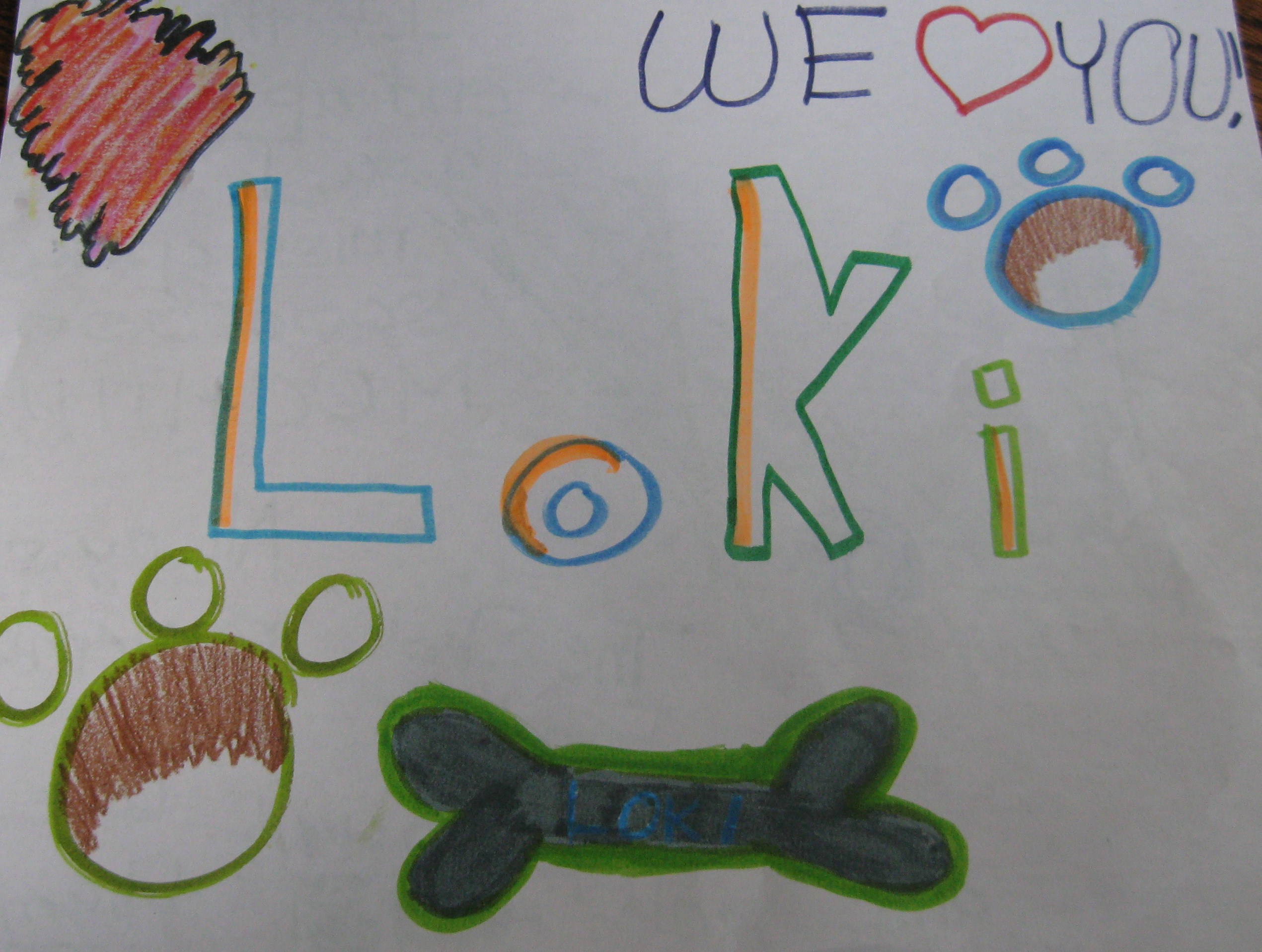
My seven-year-old has taken the decision hardest.  She drew Loki a card.  It reads, “If they end up keeping you, I’ll miss you sooooooo MUCH!!!!! Always remember us.  Love, the Skole family.”  

Dhani’s letter.

***

Loki seems very happy in his new home.  He has a large tree-filled yard to romp in, lots of sticks to chew on, and my mom is already spoiling him: In the evening, Loki settles into a prime spot on the couch right next to her.

As for fostering, I am in awe of those who do it.  One of the co-founders of Catnip told me that fosters are the life-blood of a rescue organization.  Perhaps, we’ll try again.  The need for foster families is great.