Time is what you make of it

When Gryffin died, Kevin and I were shocked – shocked because we’d had no warning, shocked because he was only ten. We used to joke that we’d have him “forever” – or at least for 14 or 15 years. After all, he was a mutt, and they outlive their pure-bred brethren, don’t they?
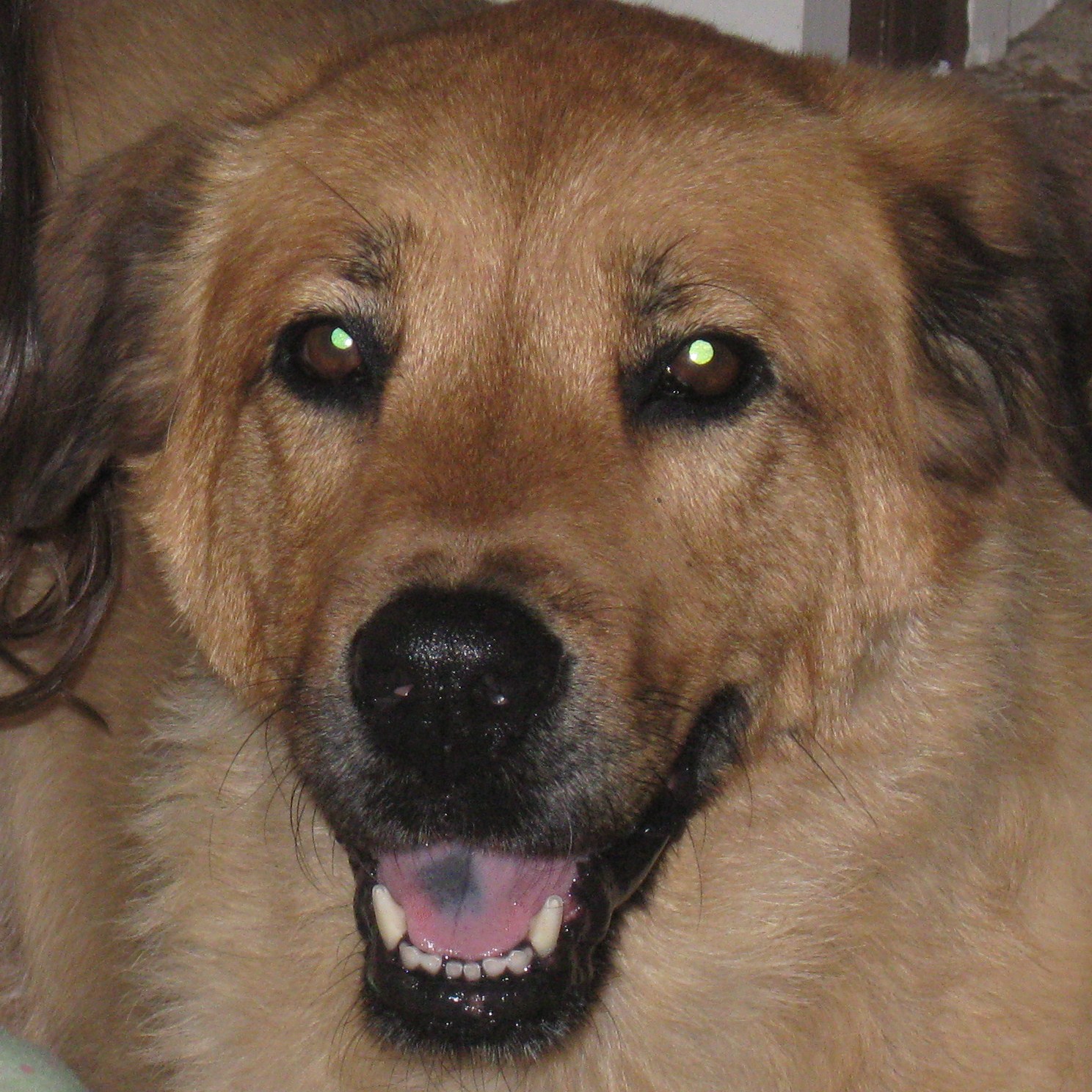
Gryffin

Gryffin

Two months later — still floundering in the fog of grief, we adopted Galen; she was eight weeks old, four weeks younger than Gryffin was when we adopted him. It never dawned on me not to adopt a puppy. The younger the dog, my subconscious whispered, the more time before good-bye.

With thinking like mine, what’s to become of older dogs on the rescue circuit? Fortunately, there are (many) people wiser than I am, who know that time truly is what you make of it.

My second guest post comes courtesy of Jane from Knoxville.

Goldie was ten when I first saw him. He was brought to a meet and greet that the Golden Retriever rescue group I was working with was participating in. His coat was thin and patchy and shaved from mid-tail to mid-hip. The bare space was covered with a long series of broad stitches. What had been there, I was told later, was a growth the vet tech described as having the size and appearance of “an exterior brain” on a stalk. He was thin. He weighed 52 pounds. His eyes smiled softly, as softly as his tail wagged whenever anyone came up to greet him. Few did. Most were occupied with the gorgeous, blonde, two year-old, fluffy Golden girl I was attempting to hold.

Goldie

Goldie

I kept looking back over my shoulder at him. He would return the glance. At the end of the event, he would have to go back to the vet’s—not for any medical reason, only because he had no foster.

I watched as he introduced himself gently to anyone who would come up to him. And I couldn’t stand the thought of him in a cage. I asked a leader in the group if I could take him home. She smiled when I asked. I think she knew that’s where he’d stay.

And stay he did in my studio apartment with me and the Shih-tzu a generous woman had given me a few months earlier when she decided he needed a chance at more attention than he was getting. Me, Oreo, and Goldie in my tiny apartment.

But Goldie was happy. I am not sure how many of the ten years he’d lived had been outside, but the old boy loved the air conditioning, the soft carpet, the eight cups of dog food I gave him daily to get his weight up and being close by, so he could stick his big wet nose over the edge of the bed whenever he felt like it. He didn’t seem to mind that the apartment was small.

A walk was good, too. He and Oreo and I, a comical looking mismatched bunch, would make our perambulations around the complex and he would stop to greet, in fact, he would insist on greeting whoever we passed. I have come to call it “Goldie running for mayor.” Soon, little scaredy Oreo was following right behind him and whoever we happened on to had better not be in too much of a hurry to stop and socialize with these unlikely twins. Or they would get an affronted look. A really affronted look.

Once we passed some boys playing soccer. Goldie’s head came up. He was alert. His big ears swiveled forward. He watched, stolid and earnest. The tail flicked back and forth. I could tell he was remembering. I could tell that as surely as if he had said it out loud. And it was a happy memory. But he didn’t yank on the leash and try to join in. He seemed to know he couldn’t do that now. But he could cheer them on. Even if it was from the sidelines. It was a lesson.

It was by no means the only lesson. Goldie was chosen to be a “Ruff Reading” dog. I accompanied him to the kindergarten class where tiny, delighted students practiced by reading him books about frogs and birds and sometimes even dogs. After a couple of books, he’d put his big head on a small lap and lick the book maybe or stick out a paw as big as one of the kid’s hands in thanks. And they would pet him. And pet him some more. When the teacher wasn’t looking, a kid or two would run over and sneak a kiss on his head. And he would lay there calmly. I think he was smiling.

Puppies and young dogs are full of their own delights. Adopt an old dog and you’ve come as close as you may ever get to having an angel in your house.

Once, when I took Goldie to the vet, a man said. “Now there’s an old guy. How long do you think you’ll have him?” I have no idea why someone would ask a question like that. The answer is this:  All we’ve got is this minute. And the next one. And the next one. And however much love we can fit in them.

Goldie had to have another surgery to remove some golf ball sized cysts on his back and neck. More fur shaved. More stitches. The girls at the vet’s office who let him sit up front with them in the reception area called him “Frankendog.” But now he has a dense curly coat of gold and silver. He weighs 70 pounds. And he will be 12 in May. Oreo licks his ears and lies down next to him on his bed.

I thank him for being here. For making the minutes full ones.
Grab a tissue… or two, or three

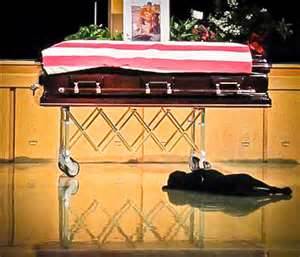
You’ve probably seen the heartrending photo of a Labrador retriever lying in front of his owner’s flag-draped casket. If not, here it is:

casket

The dog is Hawkeye; his owner, a Navy SEAL, was killed in Afghanistan in August 2011, when a rocket-propelled grenade hit his Chinook helicopter. The photo – and the story – went viral as an iconic depiction of the profound bond between people and their pets.

Now comes Tommy, a seven-year-old German shepherd in San Donaci, Italy, who has been attending mass for the last two months at the church where his owner’s funeral was held and where, before she died, they attended mass together daily.

Tommy in Santa Maria Assunta church

Tommy in Santa Maria Assunta church

You can read the full story here.

But so far as I know, only one dog has been memorialized in bronze for his exceptional loyalty.

In 1924, Hidesaburo Ueno, a professor at Tokyo Imperial University adopted an Akita he named Hachiko. Each morning, dog and owner would walk to Shibuya Station, where Ueno would catch a train to the university.

Each evening, Hachiko would return to the station to welcome the professor home. But on May 21, 1925, Ueno didn’t return; he’d died after suffering a stroke during a faculty meeting. From that night on, for nearly ten years, Hachiko returned to the station at precisely the time Ueno’s train was due to arrive.

A newspaper story about the loyal Akita lured people from all over Japan to visit him. In 1934, a bronze statue of Hachiko was erected in front of the station’s ticket gate with the dog on hand for its unveiling. During World War II, the Japanese melted the statue to use its bronze for the war effort, but in 1948, the original sculptor’s son created a replica, which still stands today. The statue is said to be one of the most popular meeting places in all of Tokyo.

Hachko's statue in Shibuya Station

Hachko’s statue in Shibuya Station

Hollywood knows a good story when it hears one, and Hachiko’s was too good to pass up. Thus:  Hachi: A Dog’s Tale, A True Story of Faith, Devotion and Undying Love hit U.S. theaters in 2009. The story is true only in the Hollywood sense; produced for an American audience, it is set in a quaint New England town, and the professor is played by a very handsome Richard Gere. Joan Allen is Gere’s wife, and Jason Alexander is Carl, the train station attendant. My family rented the movie a couple of years ago and cuddled on the couch to watch it, without any notion of its Japanese roots.

Reading about Tommy started me thinking about Hachi, the movie, and then Hachiko, the dog. And then I thought about my dogs. For me, Galen is more than a companion or a best friend – she is a deeply loved member of my family, as was Gryffin before her. I’m not alone in my thinking. A 2011 Harris poll found 92% of dog owners considered their pooch part of their family.

Back to Hachi:  The movie is definitely worth watching.  Just be sure to grab a tissue… or two, or three.

Actually, grab a whole box. If you’re anything like me, you’ll need it!

***

I can still see my first dog. For six years he met me at the same place after school and convoyed me home—a service he thought up himself. A boy doesn’t forget that sort of association.

– E.B. White, author of Charlotte’s Web and Trumpet of the Swan

They think, therefore they are

One of my favorite and most difficult courses in high school was AP Social Studies with Mr. Grasso. He introduced me to philosophy, and if not for his class, I’m not sure I would have gotten through the one philosophy course I took in college. Some of his teachings have even stayed with me after all these years, like Rene Descartes’ “Cogito ergo sum“ – “I think, therefore I am.”

I came across Descartes again recently, in an unlikely place.  I was reading Patricia McConnell’s For the Love of a Dog: Understanding Emotion in You and Your Best Friend. It turns out that Descartes, the French philosopher, mathematician, and writer regarded as the Father of Modern Philosophy, was a dog killer.  Descartes believed that dogs did not have the capacity to think, that they had no emotions and no feeling, even for pain.  McConnell writes:

[Descartes] illustrated this principle by nailing live dogs to barn walls and eviscerating them. While the dogs writhed and screamed, he told the crowd of onlookers that their struggles were merely automatic movements of the body – no more felt by the dog than a clock feels the movement of its hands.

Wow.

McConnell points out that as recently as 1989, educated folks shared Descartes’ crazy ideas. One philosopher she cites argues that because dogs can’t feel anything “concern about them is unethical, because it takes time and money away from helping humans.”

Again: Wow.

I hope anyone who’s spent any time with a dog would see the outrageousness of all this. On a daily basis I see the wheels in Galen’s head spinning (though my husband will often point out that at times they spin quite slowly). Case in point:  A couple of weeks ago, I walked into our laundry room, which doubles as a mud room, and began lacing up my sneakers. Galen followed, and  upon seeing the sneakers started wagging her tail and smiling, as she presumed we were either going for a walk or heading to the backyard to play with her favorite purple ball. Unfortunately for her – and for me – my destination was the supermarket. When I told her so, her tail quit wagging and her expression turned from expectantly happy to sad, leaving me guilty and wondering, “Couldn’t I have chosen a different pair of shoes?”

Galen’s connecting a walk with my sneakers could have been more Pavlovian than intellectual, but the only explanation I have for why her tail wagging stopped and her face fell when I told her she wasn’t coming with me is that she understood.

Fortunately, anecdotes such as this – that point to an intellectual capacity in canines or a thought process of some kind – are starting to have the support of science and scientists who study human and canine brain structure and brain chemistry. It’s just too bad the science wasn’t there for Descartes. Then he could have extended his cogito to canines:  They think, therefore they are, and taken a dog or two as a pet rather than using them for sadistic experimentation.  

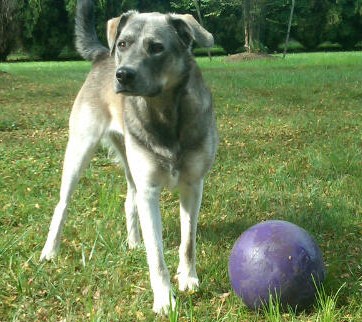
Galen

Galen, with her favorite ball. Despite others littering our yard, she will play with no other.

Dogs aren’t the only ones to drop the ball

Albuquerque, New Mexico has a puppy problem. In December, city shelters took in 347 abandoned or surrendered puppies. That number, of course, doesn’t include all the adult dogs that also entered the shelter that month. So what will become of all these potential pets? The shelters and rescue groups will do their best to adopt them out. But the reality is that a number of the dogs – and puppies – will be killed.

According to the city’s Animal Welfare Department, “Every year, thousands of kittens and puppies are born into short lives of suffering and death in Albuquerque because people did not spay or neuter their pets. There are simply not enough homes for the animals that are born because of this type of neglect.”

This “neglect” is certainly not unique to residents of Albuquerque; all over the country there are people who find one reason or another not to spay or neuter their pet. But the city is launching a campaign it hopes will result in fewer litters. The campaign is one part media blitz – public service announcements, banners on buses, and water bill inserts will proclaim the import of spaying and neutering – and one part action – the Animal Welfare Department will offer free and low-cost surgeries to low- and moderate-income residents.

I learned about the public service announcement via a KOAT-TV news story on the web. I love the PSA. I dislike the news story.

First, the PSA. The idea behind it: If you think an unintended pregnancy is a serious problem for you, you should know it’s just as serious for your pet – and its offspring. In one scene a good-looking young couple sits at a kitchen table with an open pregnancy test in front of them.

Woman: I can’t believe this is happening.
Man: It was your responsibility.
Woman: I should have gotten her spayed when I had the chance.
Cue the cat: It jumps onto the table and meows loudly.

In another scene a man is watching TV when the phone rings. Upon answering it he hears a male voice yell, “Your boy got my girl pregnant!” The “boy” is the handsome husky viewers see chewing a bone on the couch. “I knew I should have gotten you neutered,” the man says to his dog.

It’s a great ad: Hopefully the humor will get people watching and the message will get people acting.

Now to the news story, which you can watch here. It got my journalism hackles up for two reasons. First, the light, fun tone of the story belies the seriousness of the issue it’s covering. For example, the reporter leads into her story saying of the city’s problem, it’s “a cute one.” Second, and this is really what’s most significant, is nowhere in the news story does the reporter explain the tragic consequences of pet overpopulation. It’s not crowded shelters, as mentioned in the piece. It’s the unnecessary euthanizing of healthy animals. This fact – perhaps the most important in a story about pet overpopulation – was completely left out.

What do you think? Am I critiquing this story through an advocate’s eyes rather than a journalist’s? I don’t think so. What I do think is that the city of Albuquerque deserves kudos for its campaign. As for KOAT-TV, it dropped the ball on a very important story.

Guest Post: The best pet of all!

Today’s musing comes courtesy of my eight-year-old daughter via a third grade writing assignment that asked students to write an essay about their favorite pet.

***

A dog is my favorite pet, and why? You are probably wondering. This is why. First because they are cute and cuddly. There are so many different kinds that when you go to the shelter to get a dog, you don’t know which one to choose because they are all so adorable. Also, because they are fun to train. When we got our dog after the first died, she was such a pleasure to have for a new pet.  And we played a lot with her. She was very energetic, so we took her to Doggy Daycare, and it changed everything.  We also didn’t have to teach her to sit. When someone held up a treat, right away she would sit. And lastly, because they are the best things to help you cheer up. My dog always cheers me up when I cry.  And when we were at a New Year’s party, I was fooling around with a pool ball with my friend, and the pool ball hit my finger and it hurt badly. Lucky for me they had a dog. And she cheered me up plenty. Dogs are my absolute favorite pet so I am thrilled to have one. Do you have a dog?

***

I love this essay for so many reasons (beyond the obvious maternal pride in a daughter’s creativity and near flawless grammar and punctuation.) But what struck me on first read was her declaration that people adopt dogs from shelters.

Not pet stores.  Not breeders.  Shelters.