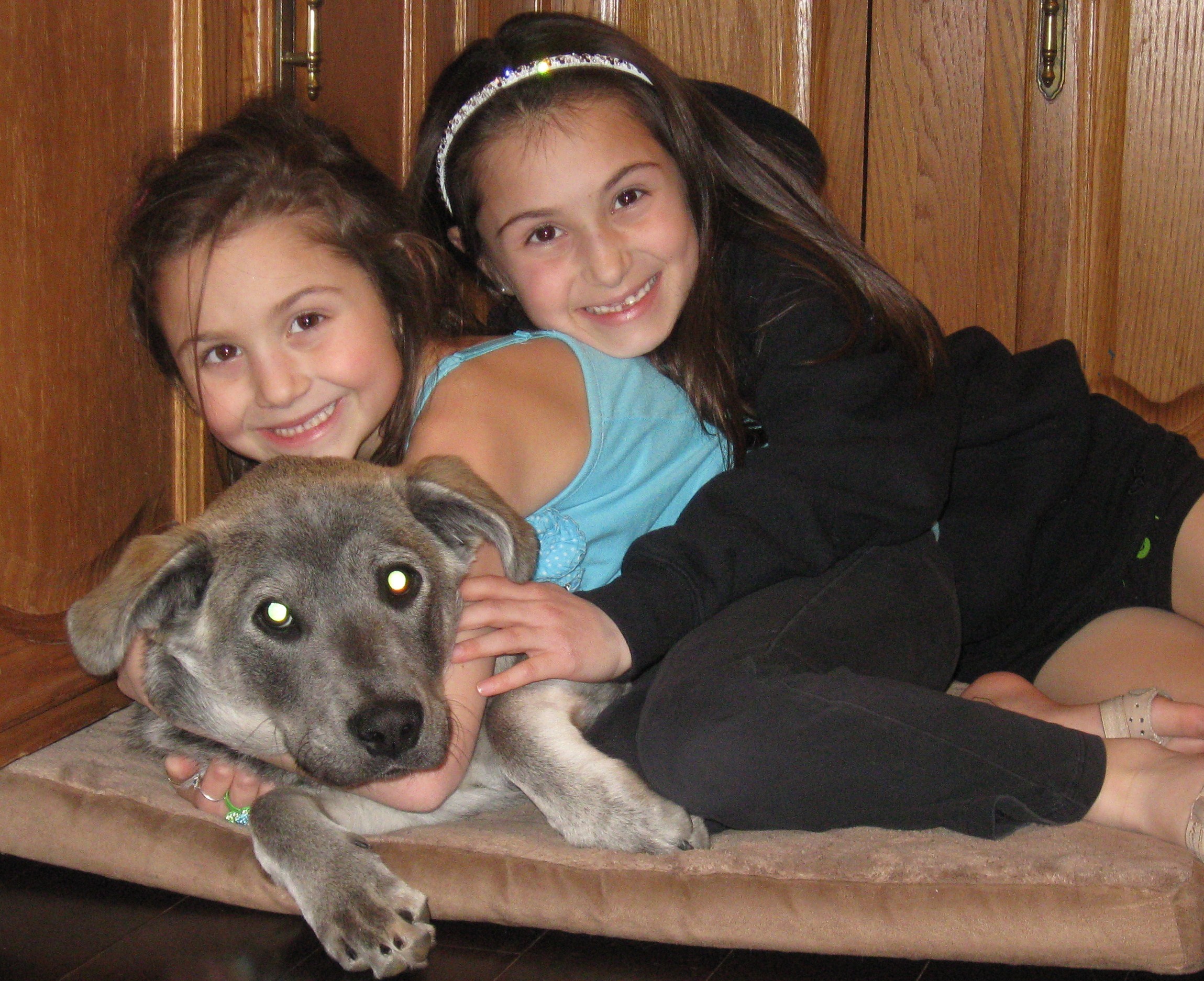
Have you hugged your dog today?

A story out of South Carolina about a dog, a toddler, and a babysitter is getting a lot of play on the web.

Briefly:  When a dog becomes aggressive toward the family’s babysitter, the parents take action – against the sitter, not the dog. They tuck an iPhone between a couple of cushions in the couch and capture the sounds of the sitter cursing and slapping the child. The sitter is ultimately charged with assault and battery. She pleads guilty and is sentenced to one –to-three years in prison; she will also be registered on a state list of child abusers and will not be permitted to work with children in the future.

No doubt, the family’s dog is a hero.

But this story has other heroes, too: the child’s parents. I say this not simply because they hid an iPhone and got the goods on the sitter, but because of the trust and respect they have for their dog.

When the dog turned aggressive toward the sitter, the parents could have found fault with the dog, asking themselves, asking the dog, “What’s with this behavior?” They could have reprimanded the dog.  They might have thought the dog was being overly protective and could perhaps pose a danger to non-family members visiting the home. Or they might have had concerns about whether the dog would turn its aggression on their son.  Their focus could have been: What’s wrong with our dog?

Fortunately, it wasn’t.

How wonderful that their instinct was not to reprimand the dog. How wonderful that they had such faith in their four-legged family-member that they saw the aggression as a message that something was awry, dangerously awry.

If not for that faith, this story could have turned out far differently.

Every day people surrender dogs to animal shelters throughout the country. Sometimes they do so because, they say, their dog is aggressive. I’m sure in many instances the owner is absolutely right and the dog presents a danger to whoever it may meet; the dog is a time bomb. But I’m also sure that there are times that a dog is just rambunctious, or untrained, or claiming “aggression” seems a way to surrender a dog, no questions asked.  In many of these cases, the shelter is the end of life for these innocent animals.

So, let’s celebrate this amazing dog. And let’s also celebrate its parents, who listened to their dog when it had something so very important to say. And let’s all take a moment to thank our own dogs for their love and loyalty, and for being the guardians and protectors of our families.

“I don’t get people.”

“I just don’t  understand why animals are treated this way.  I don’t get people.”

This statement was uttered months ago by Linda Wilferth, who runs Catnip Friends Rescue. We were talking in a Flemington, New Jersey pet store, in the company of the puppies and dogs, kittens and cats, she’s rescued from Southern shelters, and in the case of some her cats – right off of New Jersey’s streets. Linda wasn’t referring to any particular dog or cat or situation – just to the plight of mistreated animals at the hands of humans.

I thought of Linda’s comment after reading about the recent dog-fighting bust that spanned four states – Alabama, Georgia, Mississippi, and Texas; led to the arrest of twelve people; and the seizure of firearms, drugs, and more than $500,000 cash. It was the second largest dog-fighting bust in U.S. history. The federal raid was three years in the making.

But what now of the dogs – the 367 of them who range in age from just several days to twelve years? According to the ASPCA, the dogs “had been left to suffer in extreme heat with no visible fresh water or food. Many [were] emaciated with scars and wounds consistent with dog fighting, and some were tethered by chains and cables that were attached to cinder blocks and car tires.”

How many will be able to be rehabilitated after living such abuse-filled lives? How much fear of humans these dogs must foster in their abused bodies and souls. Yet, it will be left to humans – experts at places like the ASPCA and HSUS – to try to help these dogs overcome their fear of people, in the hope they can live out their lives with those who will treat them with the love and the respect they – and all dogs – deserve.

The puppies have the best shot at rehabilitation, as they have suffered the least, if only because of their short lives.

This puppy wears a chain typical of dog fighting victims.  - ASPCA

This puppy wears a chain typical of dog fighting victims.
– ASPCA

You can see more pictures of this puppy on the ASPCA’s blog, and you can read one rescuer’s firsthand account of what he witnessed at one of the properties.

The puppy after being rescued. - ASPCA

The puppy after being rescued. – ASPCA

Looking at this puppy’s sweet face, I can’t help but echo Linda’s simple statement.

“I just don’t  understand why animals are treated this way.  I don’t get people.”

A mother is only as happy…

I have a lump in my throat – the kind that grows large when you’re holding back tears, when you know everything is okay, but still, your emotions get the best of you.

I used to get this feeling when I dropped off my now eight-year-old at daycare, back when she was two-years-old. On good days, she cried when I turned her over to her teachers. On bad days, she threw tantrums. I would kiss her, tell her I loved her, and leave. Then, as I’d drive to work, that familiar lump would form; my eyes would burn, but I didn’t cry.

You see, I knew my daughter was in good hands. I also knew – because her teachers told me repeatedly – that as soon as I was out the door, the crying ceased. Indeed, at day’s end, I always picked up a smiling, happy child.

With Galen, it’s different.

I dropped Galen at my mother’s house this morning, because my family is going away for the weekend. Galen loves my mother and loves swimming in her pool. But she doesn’t love being away from her family, and she’s not so enamored with my mom’s dog, Loki, who overwhelms her with his energy.

Today, Loki swatted Galen across the head with his right paw, before she crossed the threshold into the house. He was ready to play; she was not. She cowered, tail between her legs, right cheek brushing the welcome mat.

I stayed for just a few minutes, talking with my mom. Galen didn’t leave my side. She pawed my leg with her sharp little nails and gazed at me with her big brown eyes. “Please don’t leave me here,” they pleaded.

My mom is running a boarding house this weekend. In addition to Galen, she’s watching my sister’s dog, Bear; he’s there when we arrive. Bear is a thirteen-year-old black Lab, who lives his life like that tortoise from the classic children’s tale, The Tortoise and the Hare. Bear is a “slow and steady wins the race” kind of guy, which, despite the decade-large age gap between him and Galen, endears him to her. Galen’s tail wags when she sees Bear.

In the kitchen, I patted Galen’s head and gave her a kiss. I told her I loved her, walked out the door, got in my car. I’ll call my mother in a few hours to check on my little girl. But if the past is prologue, that lump will remain lodged in my throat until Monday, when I see Galen again.

My canine daughter is not as resilient as my human one.

Galen will likely spend her weekend hiding under the coffee table in my mother’s living room – I think she believes Loki doesn’t see her there. Perhaps Bear will lure her out, perhaps my mother will.

As for me, I will have a wonderful weekend with my family, but it will be tinged with the sadness of knowing that Galen isn’t happy, despite being well cared for (read: spoiled) by my mother.

It’s been said, “A mother is only as happy as her saddest child.” I don’t know who said it first, but I would like to believe she was including her canine kids in that sentiment.

Our Diva Dog

Galen loves daycare. In fact, most mornings she stalks Kevin as he dresses, hoping he’ll take her there on his way to work. She doesn’t always get her wish. Good daycare – for dogs, as for children – isn’t cheap.

But this morning, Galen was in luck.

Kevin called me after dropping her off. “Let me tell you about our diva dog,” he said.

Apparently, Jen, who works the early shift, greeted Galen with, “Good morning, Miss Galen.” To Kevin, she said, “[Galen] will be getting her nails done at 2.”

“This is why I work and have nothing to show for it,” Kevin quipped.

(Disclaimer: Galen gets her nails clipped at daycare; she does not get manicures.)

Galen the diva in her crate

Galen
the diva in her crate

Kevin and I decided long ago that Galen is a diva. She’s been known to take bones out of the mouths of Bear and Kuma, her canine cousins. Or show no interest in a toy until Loki, my mother’s dog, picks it up. She can also be downright discourteous. Galen will turn her head away from Loki when he lies down beside her or give him the cold shoulder when he tries to play with her – unless, of course, she’s in a playful mood.

Even with us, Galen can be a tad tempermental. One night she sleeps in bed with us, the next she chooses her crate over our company. Some evenings she wants to play fetch, some evenings she prefers a walk through the neighborhood. She enjoys chewing bones and bully sticks, but only in the backyard. She refuses bones offered to her in the house.

Did Galen come by her diva-ness naturally, or is this something we nurtured?

The debate whether nature or nurture – our genes or our environment – shape our personalities goes all the way back to Plato, who favored nature. Centuries later, John Locke argued individuals are born with a tabula rasa or clean slate and thus, are shaped by their experiences, nurture. Today, most people agree both nature and nurture shape us into who we are.

Researchers are now examining canine personality. And it’s no surprise, perhaps, that their findings reflect a mingling of nature and nurture here, too. In The Genius of Dogs, evolutionary anthropologist Brian Hare writes, “How we nurture a dog affects how they behave, but so does their nature.” In some breeds, their nature can be genetically traced back to their ancestors, the wolf.

In the end, I suppose it doesn’t matter whether Galen was born a diva or whether we coaxed the diva out of her. She is one, and we allow her to be.

We’ll have to be a bit more heavy-handed when it comes to how we raise our daughters.

Give Pits a Chance

Say, “pit bull,” and you find most people have strong opinions about the breed, and more often than not – at least among the people I know – their opinion isn’t favorable. In fact, it’s downright hostile. Mostly, it’s because pits get bad press. They’re in the news for attacking someone or for being the canine of choice in dog fighting rings.

Some people would like to outlaw the breed and are working at different levels of government to make that happen. I’m not at all sure that’s realistic. Are we going to round up every pit bull for mass euthanization? (It’s kind of like the immigration debate. Can we round up and deport all undocumented immigrants? The undocumented are here; the pit bulls are here. We’ve got to work with the facts as they exist.)

This past weekend I met several members of the Luzerne County Pit Bull Owners Group (LCPO), a nonprofit out of northeastern Pennsylvania committed to educating people to be responsible pit bull owners, and to rescuing and re-homing homeless pit bulls. The work LCPO does on behalf of these misunderstood and often mistreated dogs is truly inspiring.

I arrived at Alana Rickard’s Wilkes-Barre-area home a little before one on Saturday afternoon, so I could be on hand for the arrival of ten Tennessee pits – a mom and her nine ten-week-old pups. A shelter in Blount County, Tennessee, had reached out to the group’s founder, asking her to help them help the dogs.

Momma looking at her pups

Momma looking at her pups

Waiting with me was a team of volunteers ready to care for – and to socialize – the puppies until permanent homes can be found for them. Alana planned to foster the mom, who was thought to be one, maybe two years old – practically a puppy, herself.

Adopting any dog is a major responsibility, but the responsibilities that come with adopting a pit bull are magnified a hundred-fold because of the burdens these dogs carry. Responsible owners can make the difference between a pit that thrives and a pit that ends up on the evening news.  And that’s why LCPO offers anyone who adopts a pit bull, or owns a pit bull, assistance, training, and education.

Such sweet faces!

Such sweet faces!

***

LCPO is an all-volunteer organization that runs on donations and a network of about fifty foster families in Pennsylvania, New York, New Jersey, Delaware, and Connecticut. Despite being only two-and-a-half years old, they’ve helped several hundred pit bulls. You can read all about LCPO at their website; you can like them on facebook. Also check out Leroy and Company, a blog written by Casey Heyen, the group’s Director of Volunteers. Casey took home a pup on Saturday, named it Marshmallow, and is already recounting Marshmallow’s adventures.

Saving lives… one photograph at a time

There is something compelling about a dog’s face – its physical contours, its expression.  And the eyes – the eyes seem to have so much to say. I often stare into Galen’s dark brown eyes, wanting desperately to know what she’s thinking.

I recently came across some photographs that resonated with me more than any I’ve ever seen, for they are as powerful as the dogs they feature. Just drink in these faces.

6967_107383916137757_476809578_n Percy2_81483933978_107382169471265_690808528_n

ice_frosting2_82263

Each of these dogs is a shelter dog, and each portrait is part of an on-going series called Landfill Dogs. Since being photographed some have been adopted. Some still sit on the canine equivalent of death row.

The portraits are the work of photographer Shannon Johnstone, who is crusading to save dogs’ lives one photograph at a time. Each week, she takes a dog that’s been in North Carolina’s Wake County shelter for at least fourteen days – that will be euthanized if not adopted – to a landfill-turned-county-park to be photographed for the shelter’s website.

“Each dog receives a car ride, a walk, treats, and about two hours of much needed individual attention,” she writes on her website. “My goal is to offer an individual face to the souls that are lost because of animal overpopulation, and give these animals one last chance.”

I saw Shannon’s photography for the first time in late 2012, after she had completed Shelter Life and Discarded Property, two series chronicling life and death in North Carolina animal shelters. According to her site, North Carolina euthanizes more than 250,000 dogs and cats annually simply because they are homeless.

The photos in the Discarded Property series are graphic – close-ups of dogs and cats being anesthetized, dead dogs splayed on a shelter floor beside their feces, a freezer piled with cat carcasses, a large black garbage bag filled with dead kittens.

“Those pictures are hard to look at,” Shannon said when we spoke by phone. “They ended up repelling people as much as they attracted them.”

That’s, in part, why this latest project takes a different approach to telling the story of the state’s overpopulation problem. Shannon hopes that these portraits will inspire adoptions and increase awareness of the plight of homeless animals.

After all, from awareness comes change. And change could lead to fewer dogs dying in North Carolina’s shelters and in shelters across the country.

***

I encourage you to visit the Landfill Dogs facebook page and Shannon’s website to see more of her work chronicling the canine and feline costs of animal overpopulation.

Give up or Give in?

Galen and I took a walk today.  If she were any other dog, there’d be no need for this post; walking is what dogs do.  But Galen’s not just any dog.

I gave up walking Galen months ago, because we never got very far.  After several yards, she would suddenly lie down in the direction of our house and refuse to go on.  One can only tug a sixty pound dog so hard, for so long, before her stubbornness carries the day.

Kevin wasn’t prepared to give up.  He decided to see what would happen if he took Galen off the leash.  His discovery:  What Galen doesn’t like about walks isn’t the walk itself, it’s the leash.  Set her free, and she’s not just a happy little soldier, she’s a quite disciplined one.

I’d been hesitant to walk Galen off leash.  What if she waded too deep onto a neighbor’s lawn or chased a deer?  Would a neighbor call me out for not having her on a leash– I’m sure that violates some municipal code.

But our backyard was a swamp following an explosive rain, so I decided to unleash my dog.  She impressed me.  Most of the time Galen stayed by my side.  Every now and then she fell behind to sniff a bush or patch of grass, but then she’d catch up.  Once she half-heartedly darted toward a gopher, but as the critter ran away, she put on the brakes and returned by my side.

Raising a dog isn’t that unlike raising children.  Either way, there needs to be a core set of rules that must be followed.  But there should also be space to experiment, to push limits, even to fail.  That’s how they learn, how we all learn.

Perhaps I was too quick to give up on Galen.  By giving in, Kevin learned that we had done a darn good job of raising her, and that given her freedom, she flourished.

Currently I’m writing a book about Galen’s Southern roots and canine homelessness.  Perhaps I now have the subject of my next one:  Everything I learned about raising children I learned from my dog.

Or has someone already written that?

Galen, leashless,  in the Sourland Mtns.

Galen, leashless,
in the Sourland Mtns.

Dissed by my Dog

I’d like to say Galen and I are having issues, but really, I’m the one with the issues; my diva dog is living life exactly the way she wants.  I’m just not always included in her plans.

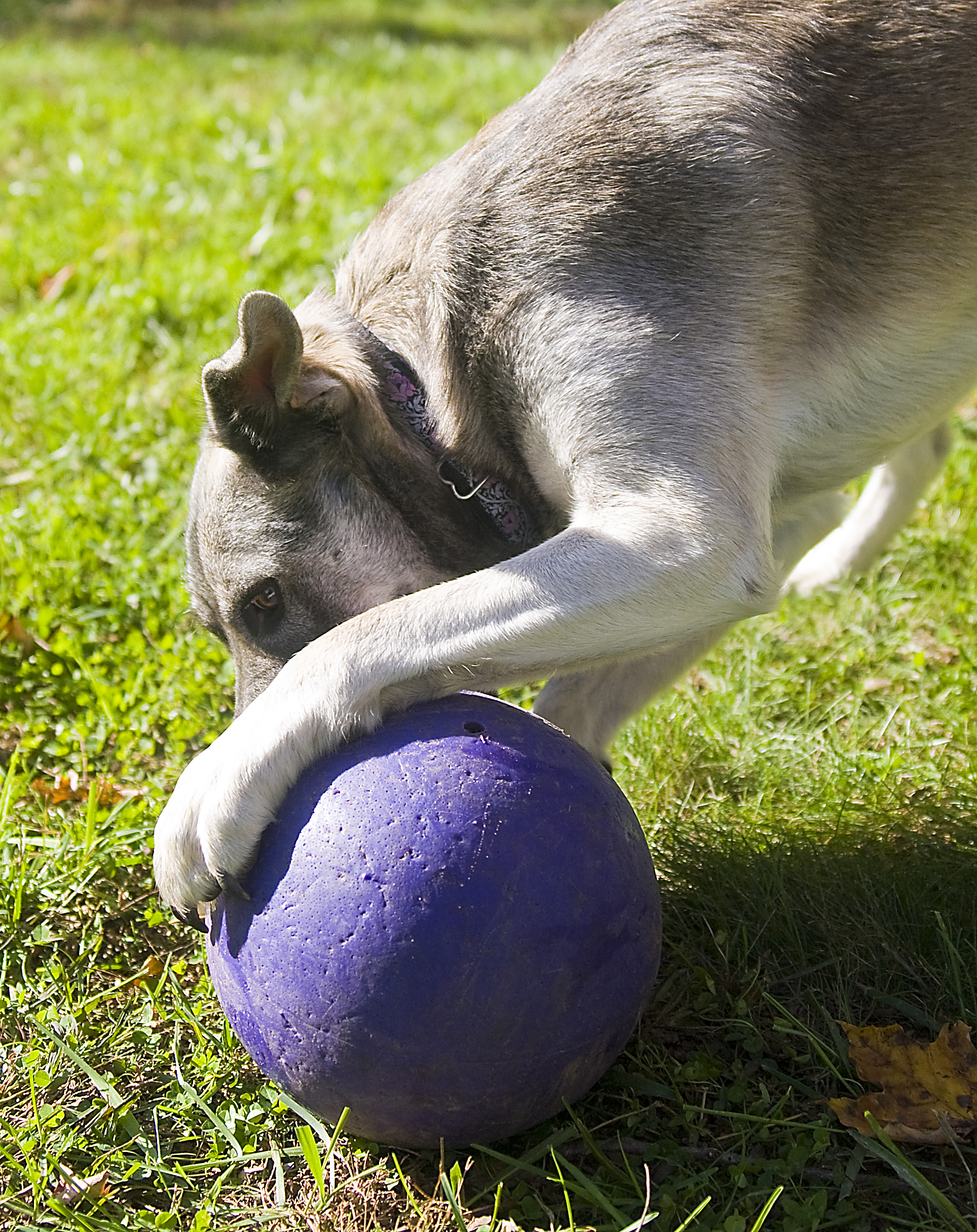
For example, Galen loves to play with these oversized green and purple rubber balls we keep in the backyard.  She’s very particular – some days she wants to play with the green ball, only the green ball; some days she wants to play with the purple ball, only the purple ball.  And she likes to play her own unique form of fetch, where Kevin or I try to kick the ball out of her mouth as she grips it in her teeth while in a downward dog yoga position.  She gives chase either when we knock the ball from her mouth or when we kick it after telling her to drop it.

Galen It's a purple ball kind of day

Galen
It’s a purple ball
kind of day

But for a couple of weeks now, she has lost all desire to play ball with me.  When we go outside and I say, “Galen, get your ball,” she turns her head away from me as if to say, “I don’t hear you.”  But when Kevin comes home at the end of the day, Galen stalks him until he takes her outside.  Then she pounces on the ball of the day and chases it all over the yard.  Her tail wags, her tongue hangs out, and she wears a huge smile on her face.

The other night Kevin had to cut their playtime short because it was his turn to pick up our daughters from dance class. I came outside to replace him, as Galen had a lot of energy she hadn’t yet worked through.  I kicked the ball and… she gave me the cold shoulder, just turned away from me.  I ran to the ball and kicked it again.  As far as Galen was concerned, I wasn’t even there.

Galen has also stopped sleeping with me and Kevin, which should make me happy, because I never wanted her on the bed in the first place, but which is actually making me sad.  And it’s not like she’s choosing to sleep on our bedroom floor like our previous dog did – Gryffin would sleep at the foot of the bed sentry-like; he was part watchdog.  No, Galen seems to now prefer the family room and her crate over the master bedroom and our bed. Last night I tried to lure her out of her crate and upstairs with a cookie, but apparently, the treat wasn’t tempting enough because she stayed put, and the treat still sits on my nightstand.

When my children were toddlers and they picked up habits I would have rather they hadn’t, a wise woman – my mother — said to me, “This, too, shall pass.”  And the habits did pass, only to be replaced by others that also, in time, went away, only to be replaced…  Another of those circles of life, I suppose.

I know Galen loves me.  She wags her tail when I walk into the room, and she whimpers and whines to welcome me home whether I’ve been gone for an hour or a day.  But where she used to be a mommy’s girl, she’s definitely more daddy’s girl right now.  I can only hope that this, too, shall pass. Because right now I’m feeling very dissed by my dog.